













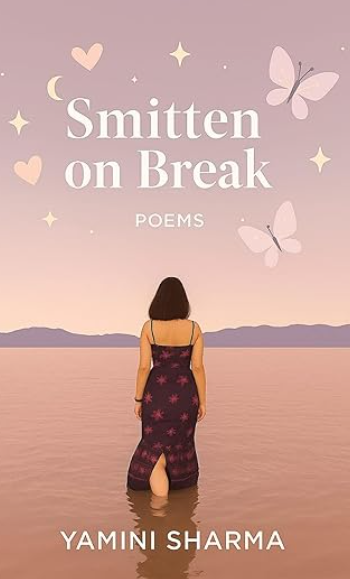
Some books are written with intention, while others evolve as the writer evolves. As You Always Said, Maybe I Won’t Remain in Your Life, At Least I Will Inspire You to Write is one such work born from romance, shaped by heartbreak, and transformed by emotional truth. What began as a tender exploration of love gradually unfolded into something deeper: an honest portrayal of longing, loss, resilience, and human vulnerability.
In this conversation, author Yamini opens up about her debut poetry collection, the emotional shifts that shaped it, and the courage it took to share her most raw verses with the world. Through reflections on love, loss, and writing as both refuge and release, this interview offers a glimpse into the heart behind Smitten and Break and the universal emotions that connect us all.
1. As you have mentioned, this book was supposed to explore romantic love. What moment or shift led it to evolve into a deeper exploration of heartbreak and transformation?
Author:
The moment I started thinking about my debut book, I was more focused on writing about love. It has always been something intimate and rare to me. People say they have felt it, but most of us actually haven’t because the depth in the world is fading. We want everything quick and hasty, as if we are running behind in life. That’s when it struck me: it’s sad. The depth has been lost, and everyone carries a void. That void makes us feel abandoned even by the smallest things things that shouldn’t matter so much, yet they break our hearts. So I realised that before exploring romantic love, sadness must be acknowledged, felt, and heard. The past two years have been a rollercoaster for the world, filled with blunt truths and heavy emotions mine included.
I wanted to put it all into words so my readers, and future readers, never feel alone. I want
them to know that we all go through pain. The extent may differ, but the hurt feels the same.
“That realization that sadness must be felt before love can be understood sets the emotional foundation of the book.”
2. How did you navigate your emotions from the ‘Smitten’ section of this book to the ‘Break’?
Author:
I wanted the book to be divided into two parts: Smitten and Break. Smitten represents love. The second part, Break, represents heartbreak. Honestly, we all feel good when we are loved, and that’s why I wanted the tone of this section to be warm, smitten, enchanting, and deep. And break is the feeling we often suppress in our daily lives, so we don’t have to confront our emotions or come face-to-face with our traumas. This section is about acknowledging that hidden hurt, the part of us that cracks quietly behind closed doors. Together, Smitten and Break tell the full story love and the heartbreak that follows, the rise and the fall, the two truths we all carry inside.
“The structure itself mirrors life love followed by loss, warmth followed by silence. It’s a reminder that neither exists without the other.”
3. Since you have written about both love and loss, does writing help in healing, or does it magnify the wounds?
Author:
For me, writing has always been a significant part of my life, ever since I was a child. It slowly evolved from reading books to writing. For people like me who feel deeply but struggle to express those feelings fully through speech or action writing becomes a way to navigate emotions and feel peace. You come face to face with your inner demons the emotions you suppress so you don’t have to surrender to them. But eventually, you do. You feel, you reflect, and you write. And somewhere in that process, without even realising it, you begin to heal.
“This captures writing not as an escape, but as a confrontation one that quietly leads to healing without demanding it.”
4. Personal texts may have writing blocks along the way. How do you deal with those?
Author:
Honestly, those moments have always been the fuel to my fire. As I said, I can’t express
myself boldly, so that’s when I find myself juggling. And in those moments, I end up writing the poetry, quotes, anything that lets the feeling breathe most. I do pause for a few minutes, sometimes an hour, but my mind never really rests. And then suddenly, the words appear raw, clear, undeniable. I write them down within minutes, as if they were waiting for me all along.
“It’s fascinating how silence and restlessness become part of her creative rhythm proof that blocks can be beginnings in disguise.”
5. What was the most difficult aspect of writing this book?
Author:
Like everyone else, I spent time arranging, writing, editing, and most importantly figuring out how to make my work appealing. I wanted to be heard, to be relatable, to truly connect with my readers. I kept asking myself: Does it sound right? Does it have depth? Is it too cringy? Will people feel what I want them to feel? After questioning myself endlessly and making countless adjustments, I finally reached a point where the manuscript felt complete honest, heartfelt, and true to what I wanted it to be.
“That self-questioning is something every writer relates to the fear of not being enough, balanced against the need to stay true.”
6. Did you hesitate to put some of those verses out because the world would have access to those emotions of yours, or did you find it liberating?
Author:
Oh yes, I was horrified until the day it finally went live for sale and honestly, I still am. I keep replaying everything in my mind, thinking about how some pieces are so raw, almost without any polish. I was hesitant, but that’s how I write, and I didn’t want to cover it up. I wanted to be related to and seen, and when people started reading it and sharing their reviews, I finally felt at ease because what I truly wanted was for readers to be able to relate to me.
“Vulnerability is terrifying, but this honesty is exactly what allows readers to feel less alone.”
7. Do you have any advice for our aspiring writers who want to write with their emotions?
Author:
Be true to yourself. That honesty will help you know exactly how much potential you have, how much more you need to learn, and which style suits you best. Keep writing even if it doesn’t make sense. Give your 100%, and then leave the rest out of your mind and in the faith of your God.
“Simple, grounded, and sincere this advice reflects the same emotional clarity found in her writing.”
8. Does the love you talk about in this book purely romantic, or does it apply to platonic love as well?
Author:
The book is mostly about the emotions I’ve felt either personally or through observing the world around me. As I said, the past two years have given all of us a lot to learn and acknowledge. I simply absorbed those experiences and put them into words.
“This openness allows readers to interpret the poems through their own experiences, regardless of the form love takes in their lives.”
9. If there’s one thing you want the readers to take away from this book, what would it be?
Author:
To feel it all deeply, openly, and as raw as it comes because trust me, that is what will take you a long way in life. I hope my writing helps you feel everything fully, makes you feel seen and heard, and I hope you learn that being emotional is okay. There is nothing to hide or suppress.
“Perhaps the most powerful takeaway permission to feel without guilt or restraint.”
10. How was your publishing experience with this book?
Author:
I learned a lot. As my first independent book, the whole process was both a learning experience and exhausting. I never imagined that publishing a book required so many tiny details and so much precision. But I’m truly grateful to the people of Papertowns who helped me at every step, and to The Book Bakers for guiding me and helping me get published. I hope my words find it’s home among you.
“Behind every finished book lies an unseen journey and this gratitude speaks volumes about that process.”
As You Always Said, Maybe I Won’t Remain in Your Life, At Least I Will Inspire You to Write is not just a poetry collection it is an emotional archive of love, loss, and quiet resilience. Through Smitten and Break, Yamini invites readers to sit with their feelings rather than escape them, reminding us that vulnerability is not weakness, but connection.
In a world that often rushes past emotions, this book asks us to pause, feel, and remember that none of us are alone in what we carry. And sometimes, that is more than enough.