













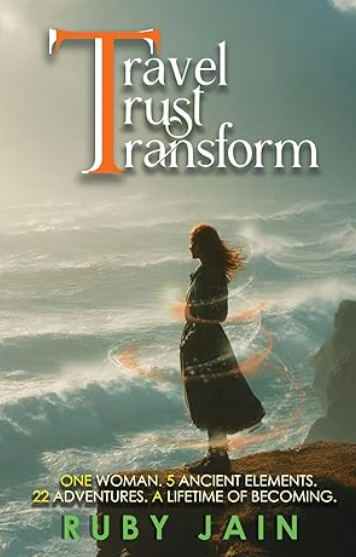
What happens when outward success begins to feel like an inward void?
In a world that celebrates achievement, promotions, and polished résumés, few speak honestly about the quiet restlessness that can exist beneath it all. In Travel. Trust. Transform., Ruby Jain takes readers beyond postcard-perfect travel stories into something far deeper a lived exploration of burnout, courage, surrender, and spiritual awakening through the ancient lens of the five elements: Earth, Water, Fire, Air, and Spirit.
From Arctic plunges to desert silence, from skydives to sacred stillness, Ruby’s journey isn’t about escape it’s about integration. It’s about what happens when the “ghost” of doubt meets the presence of something greater.
In this intimate conversation with The Bookoholics Blog, Ruby opens up about the spiritual architecture of her memoir, the vulnerability of publishing, the power of micro-courage, and how travel reshaped not just her worldview but her identity itself.
Let’s dive in.
Q1. Your subtitle mentions “5 Ancient Elements” — can you explain how these elements (earth, water, fire, air, ether, etc.) are woven into your journey and the book’s structure?
Travel. Trust. Transform. is structured around an ancient, intuitive framework: Pancha Maha Bhuta—the five elements of Earth, Water, Fire, Air, and Akasha (Spirit). This isn’t a metaphor I imposed afterward; it’s a pattern I uncovered while writing.
Across 22 life-altering adventures, each experience naturally aligned with the core lesson of one element:
Earth grounded me. Through trekking, skiing, and endurance races, I learned resilience—the courage to take the next step even when the body resists.
Water taught me surrender. In oceans, rivers, and icy plunges, I learned that flow—not control—is often the real strength.
Fire forged me. Through discipline, deserts, and moments of fear, parts of my old identity burned away, revealing clarity and courage.
Air asked for trust. Leaping from planes and cliffs taught me that freedom begins when you trust invisible forces.
Akasha (Spirit) became integration. In silence and sacred spaces, I experienced the connective field that holds all things—and my own wholeness within it.
Each chapter is a lesson within this elemental syllabus. The journey moves from outer adventure to inner pilgrimage, turning the memoir into a universal map of transformation, not just a collection of travel stories offering readers a tangible path to their own awakening.
“What’s powerful here is that the structure isn’t decorative it’s lived. The elements aren’t symbolic overlays; they’re revealed as a spiritual curriculum unfolding through experience.”
Q2. How did the process of writing this book transform you personally before you even finished it?
Writing Travel. Trust. Transform. became a second pilgrimage.
The act of shaping the manuscript revealed the elemental framework itself. I realized my adventures weren’t random experiences—they were a divine curriculum. Writing shifted me from participant to meaning-maker, from experience to understanding. There were nights I stared at the manuscript and wondered if this book should remain private—if my truth was too exposed to be shared.
It forced me to move beyond what happened and ask why it mattered. Raw experiences became embodied wisdom. Lessons clarified—not just for the reader, but for me.
Most importantly, writing rehearsed the book’s final lesson: vulnerability. Sitting alone with my truth prepared me for the courage of being publicly seen.
If the adventures were the raw material, writing was the alchemy. It completed the “Becoming” the book describes.
“It’s fascinating how the act of writing becomes its own transformation almost as demanding as the Arctic plunge or desert silence and The vulnerability here feels like the final leap.”
Q3. From shaping the manuscript to seeing the book finally released, how would you describe your publishing journey for this debut work? What was the overall experience like for you?
Publishing became the final real-world test of the book’s teachings—a lived examination of the five elements.
Moving from private writer to public author required deep surrender. Each phase embodied an element:
Editing demanded Earth-like patience and Fire-like endurance, especially when letting go of beloved passages.
Design and production required Water-like flow, trusting others to translate the soul of the book visually.
Launch and release felt like Air, an act of faith—releasing control and trusting the story to find its readers.
The core lesson was simple but profound: creation isn’t complete until it’s released. Published transformed the manuscript from a private truth into a shared offering. I questioned myself repeatedly—who was I to offer this story to the world?—until I realized the book wasn’t asking for permission, only honesty. It was the final, and perhaps most humbling, adventure of them all.
“It’s beautiful how even publishing became elemental and The journey didn’t end with the writing it expanded into surrender.”
Q4. Among the 22 adventures you describe, which one challenged you the most mentally,
spiritually, or emotionally and why?
The polar plunge in the Arctic was the deepest test.
Mentally, it was a solitary act of will against survival instinct.
Emotionally and spiritually, it created a striking duality—the violent shock of icy water
followed by profound silence beneath the Northern Lights.
Elementally, it was the ultimate lesson in Water: complete surrender.
Unlike bungee jumps (external trust) or treks (endurance) and cliffside screams
(emotional release), the plunge stripped away all comfort. It demanded presence,
humility, and absolute surrender—challenging the core of identity itself.
“The Arctic plunge feels less like a physical act and more like a symbolic death and rebirth the stripping away of comfort until only presence remains.”
Q5. Travel is often romanticized, but your book blends real life with spiritual growth. How
do you balance the beauty of travel with its harder, more transformative parts?
We see the Instagram posts—but what happens after the photo?
Travel isn’t an escape from your problems; it’s a crash course in them. The beauty matters
because of what it costs you.
Three truths guided my journey:
The view is earned, not given. The Nanda Devi summit only mattered because of the
−9°C night and brutal climb before it.
Peace is found inside chaos. The stillness of scuba diving emerged only after
confronting fear and claustrophobia.
Courage is a loud, messy yes. Freefall over South Africa came only after choosing to
jump while everything screamed no.
The magic lives after the photograph.
“This reframes travel entirely not as escape, but as exposure and The beauty matters because of what it demands from us.”
Q6. Trust is a core word in your title. How has your relationship with trust in others, in
yourself, or in the universe evolved through your life’s travels?
My relationship with trust transformed from a fragile, specific contract into the
fundamental air I breathe. This evolution followed the path of the five elements.
Earth → Trust in Self: Adventures like the Himalayan trek built physical and mental self-
trust—proving my own resilience.
Water & Fire → Trust in Process: Leaps and rapids taught situational
surrender—trusting a parachute, a guide, or a safety cord.
Air → Trust in Others: Gliding and group journeys fostered relational trust—in
companions, instructors, and shared humanity.
Akasha (Spirit) → Trust in Life: The cliffside scream and desert silence led to existential
faith—trusting the universe’s timing and support.
The journey reveals that trust is not one leap, but a layered expansion: from inner
confidence, through surrender to external forces, to a final, peaceful faith in being held.
The title captures this transformation—trust itself reshaped from a scarce resource into
an abundant force.
“Your evolution of trust from self, to others, to life itself feels like a widening circle”
Q7. The book promises insights for readers seeking transformation. What would you say is
the most actionable takeaway for someone reading your book for the first time?
Stop seeking transformation as a single, dramatic event.
Start saying yes to the small, daily adventures of trust that are already calling you.
The core insight of my book is this: a transformative life is built through micro-leaps, not
just mountain climbs. Using the Five Elements as a map, you can recognize your own
Café Moment—and act.
Earth (Foundation): Feeling ungrounded? Your yes is standing barefoot for five minutes.
This builds resilience.
Water (Surrender): Clinging to control? Your yes is consciously going with the flow for one hour.
This builds trust.
Fire (Courage): Avoiding a difficult truth? Your yes is speaking it—kindly.
This builds integrity.
Air (Faith): Overthinking a decision? Your yes is trusting your gut and taking action.
This builds intuition.
Akasha (Connection): Feeling disconnected? Your yes is sitting in silence for three minutes.
This builds presence.
Transformation is not a destination you arrive at; it’s the quality of attention you bring
to the next small, brave choice you make.
Travel. Trust. Transform. is proof that a life built on small, brave yeses—moment by
moment—adds up.
“The idea of “micro-yeses” makes transformation feel accessible. It shifts the narrative from dramatic reinvention to daily courage.”
Q8. Did any particular culture, place, or encounter radically shift your worldview in a way
that you couldn’t have anticipated before you traveled there?
The encounter with Jain monks in India became the most radical and unanticipated shift
of my journey. It quietly redefined everything that followed.
I had been seeking transformation through action—leaping, climbing, enduring. They
revealed it through supreme non-action. Witnessing their unshakable
equanimity—walking barefoot on scorching roads in perfect calm—and their internal
discipline of tapas (austerity) challenged my deepest beliefs about hardship, strength,
and purpose. This marked the pivotal moment when external adventure turned inward. They
embodied the fifth element, Akasha (Spirit), as a living reality: their silence was not
empty, but a vast space of connection with all life. It showed me that the ultimate aim is
not merely personal courage, but compassionate connection—shifting my path from
seeking experiences to seeking wisdom.
“It’s striking how the greatest shift didn’t come from adrenaline, but from stillness. Non-action as transformation challenges everything modern culture teaches us.”
Q9. For readers who haven’t traveled much, or who may feel hesitant or fearful about solo
exploration, what would you say to inspire them to begin their own journeys?
To the reader who feels the pull to explore but is held back by hesitation, I would say this: your
greatest adventure does not require a plane ticket. It begins the moment you decide to turn a
quiet “what if” into a courageous, whispered “yes”—and that “yes” can happen right where you
are.
For years, I believed adventure belonged to other people. It took me 22 journeys to realize the
most important truth: you don’t need a mountain to begin. The same five elemental forces that
shaped my path—Earth, Water, Fire, Air, and Spirit—are present in your everyday world,
waiting only for your curiosity to engage them.
Your Starter Map: Five Tiny “Yeses” to Try This Week
Think of this less as a checklist and more as a playground. Pick one—just one—and see how it
feels.
🌿Earth (Find Your Ground):
Go for a 20-minute “noticing walk.” Seriously—leave your phone. Feel your feet on pavement
or grass. Touch the bark of a tree. This isn’t just a stroll; it’s practice in being present. It’s
learning that the ground, literally and figuratively, can hold you.
💧Water (Go with the Flow):
Do one tiny thing differently. Take a new bus route. Order the mystery special at the café. Say
“yes” to that last-minute coffee invite. This is how you practice surrender. You learn that letting
go of a rigid plan doesn’t lead to chaos, but to little surprises.
🔥 Fire (Spark Your Courage):
Voice one small, kind truth. Give a sincere compliment to a barista. Gently say, “No, thanks,” to
something that drains you. Courage isn’t always a roar; often, it’s that quiet, authentic
sentence. This is how you build integrity—aligning your inside with your outside.
💨 Air (Trust Your Gut):
Follow a tiny intuition. Text the friend who popped into your head. Finally visit that cute little
shop you always walk past. Trust is built through action. Following these small nudges trains
you to hear—and listen to—your own inner guide.
✨ Spirit (Feel the Connection):
Sit in stillness for just five minutes. Set a timer, close your eyes, and breathe. Listen to the hum of your own being. This simple act is a reminder of wholeness. You are, and always have been,
part of something vast.
The “solo” in solo exploration isn’t about being alone in the world; it’s about becoming a
trustworthy, curious companion to yourself. The person who boards a plane to a new continent
isn’t magically brave. They are simply someone who has practiced saying “yes” to the smaller
unknowns a hundred times before.
Your journey of a thousand miles begins not with a step, but with the decision to untie your
shoes. Start with one elemental “yes” this week. Notice what shifts within you. That inner
shift—that newfound trust in your own capacity—is the only passport you will ever truly need.
Where will your first micro-yes lead you?
“Your “Five Tiny Yeses” feel deeply compassionate and They remove intimidation and replace it with invitation.”
Q10. How has your own sense of identity changed since you began incorporating travel as a
central part of your personal growth. Do you still see yourself the same way you did
when your journey started?
My identity evolved from a single, polished stone into a complex, fluid mosaic.
I began as Ruby, the corporate professional—a fixed self-defined by titles, structure, and
external validation. Today, I live in a state of becoming. I no longer ask Who am I? but Who am I
becoming?
The elements became my teachers.
- From Controller to the Fluent One: I exchanged the illusion of safety in rigid plans for true
security in adaptability and trust—lessons learned through surrendering to rivers (Water) and
open skies (Air). - From Achiever to Explorer: My worth shifted from promotions to presence, from outcomes
to endurance—tempered on mountain trails (Earth) and refined through inner and outer trials
(Fire). - From Soloist to a Connected Node: I moved beyond proud independence into an awareness
of interconnection, recognizing myself as part of a vast, living web—awakened through spiritual
teachings (Spirit/Akasha).
The deepest transformation was a shift from either/or to and.
I am not one thing or another. I am professional and adventurer, resilient and tender,
disciplined and free. Travel did not change my essence—it shattered the narrow story of who I
was permitted to be. In its place, it revealed a more authentic, expansive self.
I see more of myself now.
And I choose this view
“The shift from “Who am I?” to “Who am I becoming?” feels like the heart of the memoir identity not as fixed, but fluid.”
Q11. The book’s structure combining ancient elements with modern journeys is unique. What
inspired you to use this elemental metaphor as the organizing principle of your memoir?
The five ancient elements became the organizing principle because they were the only
framework capable of truthfully bridging my modern adventures with the timeless
truths they revealed.
This was an act of discovery, not invention. As I wrote, I realized my twenty-two
journeys were not random. Each had quietly taught me a core quality: resilience (Earth),
surrender (Water), courage (Fire), trust (Air), and transcendence (Spirit). The elements
offered the clearest thematic lens—allowing the story to be organized not by
chronology, but by the state of being each journey awakened.
This structure transformed the memoir from a record of what I did into a reflection of
what I learned, turning it into a field guide for inner transformation. It mirrors the
natural arc of growth itself, moving from the grounded lessons of Earth toward the
expansive surrender of Spirit.
At its heart lies a simple belief: our inner landscapes are shaped by the outer ones we
traverse. The elements became the bridge, revealing that every physical journey was, all
along, a precise lesson for the spiritual one.
“Organizing by state of being rather than chronology elevates the memoir into something universal. It becomes not just your story but a mirror.”
What lingers after this conversation is not just the imagery of Arctic waters or desert silence but the quiet insistence that transformation is already available to us.
Travel. Trust. Transform. isn’t about abandoning your life. It’s about inhabiting it more fully. It invites readers to stop waiting for the perfect moment, the perfect trip, or the perfect breakthrough and instead begin with one small, brave “yes.”
Ruby Jain’s journey reminds us that courage is rarely loud. Sometimes it is a whispered agreement with yourself. Sometimes it is unclenching your fist, finger by finger, until your hand is open to the wind.
When God meets your ghost, you don’t disappear.
You integrate.
You rise.
You remember.
And perhaps, like Ruby, you begin to see more of yourself —
and choose that view.
Grab your copy now from the online portals below and begin your own journey of courage, trust, and transformation with Ruby Jain