










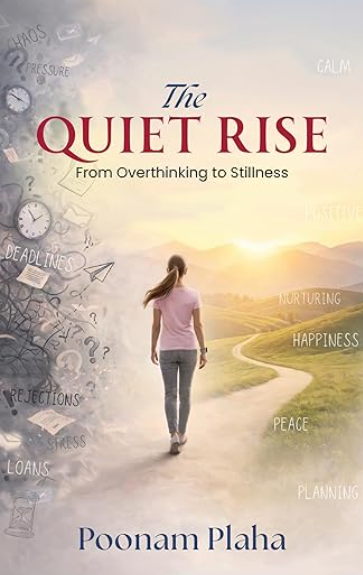
In a world that constantly demands speed, noise, and reaction, finding inner stillness can feel almost impossible. The Quiet Rise: From Overthinking to Stillness offers a refreshing and deeply insightful perspective on navigating modern chaos with calm and clarity. In this exclusive conversation, we explore the philosophy, tools, and transformative power behind the book and unpacking how silence can become our greatest strength.
Q1. What is the core message of The Quiet Rise: From Overthinking to Stillness?
The fundamental message of this book is that true strength does not require volume. We are conditioned to believe that success means shouting at the world, but the greatest, most enduring strength comes from the immovable silence within. The core philosophy is about learning to become the “Eye of the Hurricane” discovering how to carry a center of total silence and clarity inside yourself, regardless of how intensely the storm of modern life is blowing around you.
“A powerful reminder that true strength lies in inner silence, not in noise.”
Q2. How does the book help readers move from overthinking to inner stillness
It provides a systematic unlearning of the “Noisy Mind.” I help readers understand that mental noise is not something that just happens to us; it is a structure we build through three distinct layers: the Information Layer (mental clutter from endless data), the Emotional Layer (the hum of anxiety and regret), and the Ego Layer (the constant search for approval). By identifying these layers, the book moves readers from feeling like victims of their thoughts to active architects of their peace, teaching them the alchemy of subtraction – letting go of the heavy rocks of worry to walk with ease.
“A simple, powerful idea understand the layers of the noisy mind and let go to create inner peace.”
Q3. What are some practical tools shared in the book to manage mental clutter?
The book is heavily anchored in actionable practices through the “Stillness Lab” exercises. A few powerful tools include:
The Mental Inventory: Writing down every open “mental tab” to visually confront the weight the brain is carrying.
The Slow Yes: A technique to pause before committing to requests, allowing the nervous system to consult intuition rather than guilt.
The 10-Second Buffer: Creating a deliberate pause between a stressful event and our reaction to it, which strips the “storm” of its power
“This elegantly reflects how the book distills profound ideas into practical tools for cultivating clarity and inner calm.”
Q4. How can readers create a “permanent sanctuary” within themselves, as mentioned in the book?
Building a permanent sanctuary is a dual process involving both the external environment and internal boundaries. Externally, it requires decluttering the “Sightline” and cultivating a “Sacred Corner” to remove visual noise that keeps the brain on high alert. Internally, readers learn to protect their “Inner House.” I use the metaphor of a house during a storm: you can see it is raining outside, and you can even take an umbrella to help someone else, but you must learn to close the windows so the rain of other people’s stress does not ruin your own internal furniture.
“A powerful reminder to create calm externally while protecting your inner space from others’ stress.”
Q5. What role does stillness play in personal growth according to your book?
Stillness is the ultimate catalyst for high-level growth because it acts as a master healer. When the mind finally goes quiet, the body receives the biological signal that it is safe to redirect its energy toward repair rather than panic. Beyond physical healing, stillness allows access to the “Second Silence”—the silence of the ego. This is where our highest creativity and deepest intuition live. You stop growing from a place of fear and start building your life on a foundation of solid rock.
“A powerful insight-stillness heals, unlocks deeper creativity, and allows growth to emerge from clarity rather than fear.”
Q6. How does the book address the impact of a fast-paced modern lifestyle on the mind?
The book confronts the modern trap I call “The Rush.” We treat “busy” as a badge of honor, but living in The Rush is an addiction to adrenaline. I use the analogy of a rocking chair: we are moving furiously, sweating, and working hard, but achieving nothing meaningful. This adrenaline-fueled lifestyle, combined with the “Slot Machine” in our pockets (our smartphones), keeps our Sympathetic Nervous System locked in “Fight or Flight,” flooding our bodies with cortisol and leading directly to burnout.
“A powerful reminder that constant busyness and digital distraction trap us in stress without real progress, leading to burnout.”
Q7. Can you share a favorite chapter or section that you feel is most impactful?
Peace in the Storm (Chapter 9), is deeply important to me. It is easy to be peaceful in a quiet room on a Sunday morning. The true test of the Quiet Rise is maintaining your center during a family argument, a work crisis, or a sudden change in plans. The concept of dropping an “Internal Anchor” understanding that you can witness the chaos without becoming the chaos – is a paradigm shift that gives readers their power back instantly.
“A beautifully written reflection on finding calm within chaos-insightful, relatable, and truly grounding.”
Q8. How does the book encourage readers to stop “fighting the noise”?
Fighting the noise actually creates more noise. I teach the mastery of “Non-Resistance”. Fighting reality wishing the traffic was moving faster or that people would act differently is the loudest sound in the human mind. The book encourages readers to acknowledge thoughts without following them. Through techniques like the “Three-Breath Reset,” readers learn to treat their thoughts like cars passing on a street: you see them, but you don’t have to chase them.
“A beautifully crafted insight where surrender replaces struggle, the mind finds its quiet rhythm.”
Q9. How can readers incorporate the lessons of the book into their daily routine?
The book is designed to be highly accessible. Readers can start today with tiny habits, like the “Half-Speed Morning,” where they spend just 15 minutes moving, walking, and preparing tea at half their normal speed to physically signal to the brain that there is no emergency. They can implement a “Digital Sunset” an hour before bed, or practice the “5-5-5 Reset” breathing method. The goal is not to overhaul their life in a day, but to insert small pockets of peace into the life they already have.
“A gentle, practical approach that teaches small mindful habits that quietly transform everyday life into moments of peace.”
Q10. As a debut author, how would you describe your journey from manuscript to publication, and how did the support you received along the way shape your overall experience?
Well, I must gently correct the premise of the question – I am actually not a debut author! The Quiet Rise is the profound evolutionary next step following my earlier book, The Phoenix Path – A Journey to Rise Stronger. My journey writing this second book was heavily informed by my background in human psychology, allowing me to dissect the biological and emotional architecture of our mental noise. The support I received from readers of my first book revealed a crucial truth: people are truly exhausted by the modern rush and are hungry for grounded ways to heal. That feedback shaped the very heart of this manuscript, pushing me to create a practical sanctuary in book form.
“A gracefully evolved narrative where lived insight meets quiet wisdom, offering readers a sanctuary of healing and depth.”
This conversation beautifully highlights a powerful shift—from noise to stillness, from reaction to awareness, and from survival to intentional living. The Quiet Rise is not just a book; it is a guide to reclaiming calm in a chaotic world. Through thoughtful insights and practical tools, it reminds us that the most profound transformation often begins in silence.
Grab your copy of The Quiet Rise and begin your journey toward discovering your inner self.