










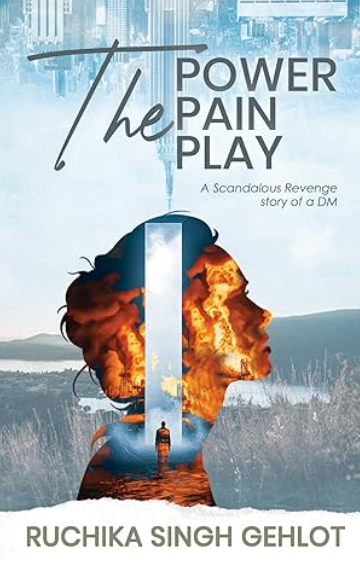
Stories rooted in power, morality, revenge, and emotional complexity often leave readers questioning not just the characters but themselves. In this compelling conversation, we sit down with the author of The Power, The Pain and The Play to talk about fictional districts, water mafias, unconventional heroes, writing without drafts, and why struggles begin after publishing.
From political tension to emotional grey zones, this interview dives deep into the mind behind the story and what lies ahead.
Q1. What inspired you to set this story in Jagmahal, a district in Madhya Bharat? Is it inspired by real events?
So Jagmahal is not an actual district in Bharat. Rather, it’s a palace in Rajasthan. I have been a student of humanities, which also includes history and fine arts hence I am aware of lot of hidden Jems of Bharat. Talking about Madhya Bharat, it’s also not an actual state. However, Madhya Pradesh and its contiguous region were called as Madhya Bharat during pre-independence times. So I just collaborated on both of these separate places and ideas. It’s just came into my mind, and felt that even though the locations in the stories are hypothetical, names should be quite relatable to people. I really love how people actually believed while reading this story that its an actual district. I feel that it means that I have done my work right!
“That blend of historical awareness with fictional imagination clearly worked your world felt real enough to convince readers it truly exists.”
Q2. How much did real-life scenarios influence you, especially in terms of the water scarcity and the water mafia plot twist?
Umm! I will not say that I have myself has experienced it in any way. Its all purely hypothetical in nature. Yet I also know that there are remotes places in Bharat where people still faces issues in fulfilling their survival needs like water. Recent report of filthy water supply and deaths in Indore which is in fact in Madhya Pradesh is one of its biggest examples. However, I am glad that these days the government is taking serious steps regarding this issue with its Jal Jeevan Mission, providing safe drinking water to people.
“Even when fictional, grounding a story in socially relevant realities makes the conflict hit harder and this clearly resonates with readers.”
Q3. What were the challenges of putting a political figure as the protagonist?
Well I would not say that my protagonist Radhika is political in profession. There is difference between a political and permanent executive. She is an administrator not legistrator, Hence she is not political in its role, yet she in political in nature the way she pulls out all the strings in the story.
Of course when I was writing about political activities, I was skeptical if I would offend any specific political party or figure. Thus while writing and choosing party names I was careful to not make feel anyone targeted. That you can see even with the district name as well.
“That distinction between administrator and legislator is important and your caution clearly helped keep the story powerful without becoming partisan.”
Q4. What does your writing process look like? Do you outline it before writing or put it on paper and then refine it in later drafts?
Ohkay! This is one of my favourite question but I will give you the most unexpected answer. Neither I made any drafts nor did I ever put it on paper. It just flew on my laptop. Its just happened so naturally. Even while writing I didn’t even turn back often how far I have come or if there are any discrepancies in the story that I m writing. I just kept writing without any review or periodic checks. In fact when my story reached to certain level of conclusion, I realised while reading it again from the start that it had all the flow and continuity with no loopholes left in the plot.
So no! there was not much refining that went into it. The only refinement was done during my rereading and then at editing phase. And thankfully, that’s why story looks organic and not mechanical in nature. This is really important since this book is not purely just a thriller. As I have already mentioned it, its an mixture of genre with Drama in it.
“That organic flow might explain why the emotional arcs feel so natural it reads like it was lived before it was written.”
Q5. What is the one thing you want the readers to take away from this novel?
That no one is perfect. Humans are grey, but what shade of grey can only be decided by their intentions. Sometimes we have to choose a different path to stand with the Right. Sometimes we have to choose a questionable path. As Lord Krishna said to Arjuna, “ pick you weapons, Parth. It is for the dharma”. No ethical dilemma should become a hindrance to the right purpose.
On entertainment perspective, I want people to feel those human emotions I wanted to portray in the story, the ones I felt while writing the story.
“That moral greyness seems to sit at the heart of your story justice isn’t always clean, and neither are the people who pursue it.”
Q6. Was there any aspect that you removed or censored out of fear of scrutiny?
Author:
No!
“That confidence is bold and refreshing.”
Q7. How do you balance the emotional with the professional in consideration of the tonality in the book?
Being a newbie author, to be honest, my goal was never to be too “professional”; rather, as I have already mentioned elsewhere, I started writing for the sake of writing, especially to put my internal feelings and conflicts into words.
I always find myself intermingled with so many human emotions, contracts, complex actions, behaviour, destiny, karma and whatnot…
So I never intended to create any Balanced work. I don’t even know what true professionalism in writing means!
“Perhaps that honesty is your professionalism the raw emotional truth feels intentional, even if unplanned.”
Q8. Is Radhika a hero, an anti-hero, or something in between?
She is a hero. No doubt in that. But an unconventional one. She is an unconventional female protagonist.
Else its onto readers to decide that. She belongs to them now.
“And that might be the most powerful transition when a character stops belonging to the writer and begins belonging to the readers.”
Q9. How was your publishing experience? Do you think the struggle ends once you complete the book, or does it extend?
My publishing was of course quite long because of some unexpected delays… One should just trust the god’s plan.
Coming to the second question, NO! Infact struggles begin here… The sales report, doubts in it, printing mistakes, delays etc are some of the issues that often keep writers awake with insomnia.
“That’s something many aspiring authors underestimate the writing may be solitary, but publishing is a battle of its own.”
Q10. What does your next project look like?
I am currently working on my next project. It will not be a political thriller… I am writing a romance…
My second book will be romance, but it will not be some rom-com. It is going to be very heartfelt… It will definitely make you feel things to your bones… And a little spoiler, it will be a true romantic novel with open-door romance… Of course, since I am writing it, it will touch on some deeper social and political topics.
“A heartfelt romance with emotional depth and social layers? That sounds like an exciting shift while still carrying your signature intensity.”
This conversation reveals a writer who trusts instinct over structure, emotion over formula, and grey over black-and-white morality. From fictional districts inspired by history to moral dilemmas inspired by philosophy, her storytelling thrives in complexity.
If The Power, The Pain and The Play asks whether revenge can coexist with righteousness, her upcoming romance seems ready to explore whether love can survive reality.
One thing is clear: this is only the beginning of a writer unafraid to experiment, question, and feel deeply and invite readers to do the same.|
Get your copy now and plunge into a political thriller where power, passion, and revenge collide