














In a world where success is often measured by titles, income, and appearances, few people stop to ask the deeper question: Is any of this truly leading somewhere meaningful?
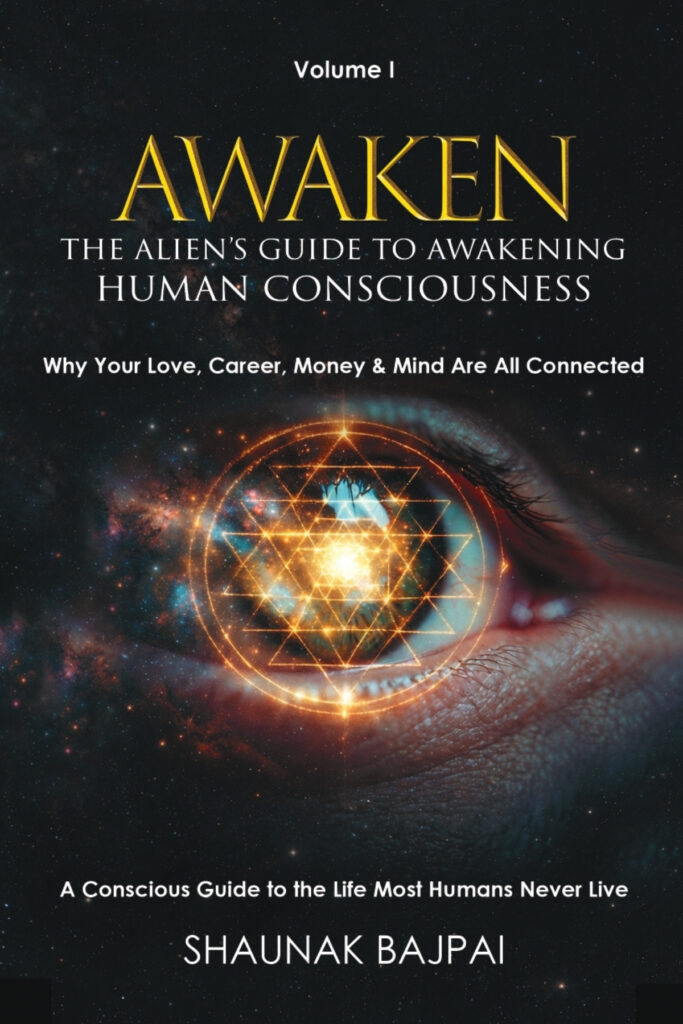
In this deeply reflective conversation, the author of The Alien’s Guide to Awakening Human Consciousness opens up about the personal experiences, heartbreaks, spiritual questioning, and inner transformations that eventually gave birth to AWAKEN.
What follows is not just an interview about a book. It is an honest exploration of consciousness, identity, love, purpose, pain, and the invisible patterns that quietly shape human life. Through every answer, the author challenges conventional ideas about career, relationships, money, and the mind urging readers to examine whether they are truly living consciously or simply repeating inherited patterns.
This conversation is for anyone who has ever felt restless in the middle of a “successful” life, anyone searching for clarity before making major life decisions, and anyone who has quietly wondered whether there is something more beneath the surface of everyday existence.
1. What was the exact moment or realization that made you think, “I need to write AWAKEN”?
There was no single moment, there were years. I watched people around me, including myself, working incredibly hard, making real sacrifices, and still quietly falling apart. Successful people who were deeply lonely. Spiritual people who were financially terrified. Loving people who had completely lost themselves. And the more I watched and observed, the more I realized that nobody had given any of us a complete map before the journey began, before life’s major decisions needs to be taken, for clarity and purpose.
The heartbreak in 2014 cracked me open and made me to start questioning, specially about the root causes of the problems in life. The legal battle in 2022 broke me to my knees, but both of these major events pushed me into temples, into ashrams, into honest silence, into meditation, into mantra chanting, into the deepest questions I had ever asked myself with curiosity and hope. Somewhere in that silence, a message started forming, not from me, through me.
I did not decide to write this book. I was left with no other honest option than sharing it with the world, with a conscious purpose.
“The honesty about heartbreak, legal battles, and spiritual seeking gives the sense that AWAKEN was not simply written – it was lived before it was ever put into words.”
2. The title The Alien’s Guide to Awakening Human Consciousness is fascinating — why “alien”? What does that perspective symbolize to you?
Because I felt something I could not quite name for years. A feeling of never having fully belonged here.
Not literally alien obviously, but deeply alienated from the way humans lead their lives, defining success without any greater purpose, chasing milestones handed to them by a world that never stopped to ask whether those milestones actually lead anywhere worth going.
There has always been a part of me that existed slightly outside the box this world built. I could never force that fit, so I chose to use that distance as a perspective instead.
But here is what I want every reader to understand. That alien part exists in you too. The part that does not quite fit. The part that questions what everyone around you simply accepts.
Not everyone gets this far though. There are humans so deeply asleep mentally, with eyes wide open, asleep in their unconscious patterns that they do not feel this restlessness or any realization at all. They suffer repeatedly in the same cycles without ever once asking why, not out of strength but out of pure unawareness. If you feel that restlessness, that is not something broken in you. It is the most awake thing about you, and this book was written precisely for that part of you.
“This perspective feels deeply relatable, especially for readers who have always felt slightly disconnected from society’s definitions of success and belonging.”
3. Was there a chapter or concept in this book that was particularly difficult for you to write because it felt deeply personal?
The chapter on love.
Not because it was painful to write, but because writing it honestly required me to look at myself without defense. Every pattern I describe in that chapter, the person who looks for completion in someone else before understanding themselves, the confusion of love with need, the control dressed up as care, I have lived those from the inside.
I did not write that chapter as an observer standing safely outside the experience. I wrote it as someone who had been unconscious in the exact ways I was describing to the reader.
What made it difficult was not the subject. It was the standard it demanded. If I was going to write about conscious love, I had to be honest about how unconscious I had been, and I knew that if I softened it, even slightly, it would stop being a mirror for the reader and become just another comfortable piece of writing that leaves people exactly where they found it.
The truth of it.
“The vulnerability in this answer is powerful. That honesty makes the chapter feel less like advice and more like a mirror for the reader.”
4. You write about the silent question many people carry, whether their life is actually taking them somewhere real. What do you think stops people from confronting that question honestly?
Comfort.
Not physical comfort. The comfort of not knowing, because if you ask that question honestly and the answer is no, then something has to change, and change is terrifying for most humans because they have spent their entire lives avoiding exactly this moment. The moment of honest confrontation or conversation with themselves.
So instead, humans stay busy. They fill every silence with noise, every empty hour with scrolling, every moment of stillness with something to do. Driven by a fear of the unknown that most of them will never even recognize as fear, because being still long enough to hear that question would mean they have to answer it, face it, and sit with what it reveals about the life they have been living.
One of the most ignorant sentences humans repeat to themselves is “I will think about it later.” Later never comes and the years do not wait, and when later finally arrives uninvited, it does not arrive as a question anymore. It arrives as regret. That quiet, specific grief of realizing you have been running hard in entirely the wrong direction.
And yet it is never too late to begin. The discomfort of change is real but it is temporary. The regret of never changing is permanent. Everything begins with a shift in perspective and perspective begins with knowledge and knowledge begins with the conscious choice to read, to seek, to ask better questions.
That effort is uncomfortable too, but it is the kind of discomfort that builds something rather than cost you everything.
It is all consequentially connected, and once you see that clearly, the question stops being terrifying. It becomes the most important thing you could ever ask yourself.
“This answer shifts the conversation from external success to inner honesty , and the warning about regret arriving “later” leaves a lasting impact.”
5. Career, Love, Money, and Mind – why do you think society teaches us to chase them separately instead of understanding them as one integrated system?
Because society rewards the specialist, and that reward comes from a place of collective ignorance and unconsciousness, not from any intention to harm.
The world needs specialists. You want a heart surgeon who has spent decades mastering one thing when you are on that operating table. That kind of specialization has its place and its value.
But most humans take that same fragmented thinking and apply it to their entire life. They specialize in career and neglect everything else. They pour everything into money and wonder why their relationships feel empty. The world celebrated their professional specialization, so they assumed the same approach would work for living.
It does not.
The education system teaches facts, not awareness. Parents pass down what they were taught, which was also fragmentation. And so the pattern repeats, generation after generation, without anyone realizing they inherited it. Nobody designed this to harm you. They simply did not know either.
These are not individual failures. They are the natural result of a map that was always incomplete. And the only thing that can correct an incomplete map is consciousness. Not perfection across all four domains, but the awareness to see how they are connected and to choose deliberately.
That is what this book is really about.
“What makes this insight compelling is the distinction between specialization and consciousness. That integrated perspective appears to be one of the central foundations of the book.”
6. In your observation, which of these four domains do people neglect the most, and what does that neglect cost them?
The mind. Always the mind.
People invest in careers, relationships, and money, but almost nobody genuinely invests in understanding how their own mind works. What it was programmed to believe, what patterns it keeps repeating without question, and what it is quietly creating in their life without their conscious awareness.
And the cost is enormous, because every other domain flows from the mind. Your career choice comes from your mind, your relationship patterns live in your mind, your relationship with money is shaped by your mind. When the mind is running on old, unexamined beliefs, everything it touches carries that conditioning forward.
The most expensive thing a human being can do is live with an ignorant and unconscious mind for decades and then wonder why life feels like someone else’s story.
“This answer highlights something many people rarely stop to consider – that the mind silently shapes every other aspect of life.”
7. You say this is the book you wish someone had handed you earlier. What lesson did life teach you the hardest way?
That you cannot succeed in one area of life by ignoring the others.
What is the point of a successful career and good money if you come home to a relationship that is slowly falling apart? and what if you cannot even see that you might be contributing to it, through your tone, your words, your absence, your stress? What if you have a loving partner at home but you are drowning in a job that is crushing you and cannot meet the responsibilities that matter?
I lived such unconscious misalignments. Fortune 250 company, good money, prestigious positions. But my relationships were shallow, my mind was at war with itself, and my inner peace was completely absent. I was the exact problem this book describes and I was too unconscious to even see it. The lesson did not arrive gently. It arrived through a heartbreak that dismantled everything I thought I knew about myself, and then again through a legal battle that forced me to my knees for years.
What I learned the hardest way is this, pain is not punishment. It is preparation, but only if you are conscious enough to let it teach you rather than just destroy you.
“There is a raw honesty in acknowledging that outward success can coexist with inner collapse. “
8. If a reader finishes your book and carries only one sentence in their heart, what do you hope that sentence is?
“You cannot change what you cannot see.”
Everything else in this book is built on that one truth. The career choices made unconsciously under pressure. The relationship patterns repeated without awareness. The money decisions driven by inherited fear. The mental loops that keep repeating themselves for decades without question. None of it can be changed until it is first seen clearly.
That sentence is both the invitation and the challenge. It is asking you to stop blaming circumstance, stop waiting for things to change on their own, and start looking honestly at what you have been refusing to look at. Seeing is where everything begins.
“You cannot change what you cannot see” captures the idea that awareness is the beginning of every meaningful transformation.”
9. If you could place this book into the hands of one person — living or dead — who would it be, and why?
My younger self. The one standing at the beginning of every major decision with no map, no framework, and no real understanding of how profoundly everything in life is connected.
The one who had what looked like an ideal career from the outside, good money, a respected position, everything society said was success, but who quietly suffocated inside the sameness of it. The same routines, the same walls, the same cycle repeating itself while something deeper kept asking whether this was really it. Who loved deeply without understanding himself first. Who chased external markers of success while his inner world quietly collapsed.
If that version of me had read this book before the journey began, years of suffering could have been avoided. Not all of it. Some of it was necessary, some of it was the curriculum. Because if I had not gone through what I went through, I would not have become who I became. My struggles and my pain were my preparation.
But the unconscious suffering, the kind that comes purely from not knowing, that could have been different.
There is something else I will say honestly. I do not have a child yet. My wife and I are navigating that journey with all its uncertainty, but I have always known that if I ever have a child, the first thing I would want them to have is this map, before the major life choices, before the pressure, before the wandering begins.
And because I do not know if that child will ever arrive, I wrote this book for every child instead. For every young person anywhere in the world who is standing exactly where I once stood, seeking, uncertain, and completely without a map.
That is who I really wrote this for.
“This may be one of the most emotional moments in the conversation. The idea of writing the book for “every child” who begins life without a map gives the project a deeply human and universal purpose beyond personal success or recognition.”
10. What was the most rewarding part of seeing your manuscript transformed into a published book?
I did not write this to see my name on a cover. I wrote it because I genuinely believed that if even one young person found this map before their journey began, something meaningful would have been accomplished. There was an honest intention of some financial return too, I will not pretend otherwise. But I could not have written this depth purely for money. That kind of wisdom does not arrive on demand. It came through me because perhaps it was always meant to.
I believe that. My birth chart, my struggles, the specific timing of everything I went through, none of it feels accidental looking back. Writing this book was not a choice I made. It was a purpose I eventually stopped resisting.
And now that it is out in the world, whether it becomes a bestseller or quietly finds the few souls it was truly written for, that is no longer in my hands. The results belong to God, or to whatever cosmic intelligence decides what reaches whom and when.
I did what I came here to do. The rest was never mine to control.
“What resonates here is the surrender behind the process. It becomes clear that the book’s deepest value, for him, lies in its ability to reach someone exactly when they need it.”
11. Was there a moment during your publishing journey with Paper Towns India that made the book feel truly real?
Yes. The moment I held a physical copy in my hands.
Not because of what it looked like, because of what it represented. It represented something far deeper than I had imagined when I first began writing it. Something shifted in me through the process of writing it, realizing what it could mean, and what it could change in someone’s life if it reached them at the right moment.
There were years when I did not know if I would survive what life was putting me through. Years of legal battle, of financial instability, of nights when the question was not what to write next but whether any of this had any meaning at all.
And then one day, there is a book. Published. Real. Something you can hold in your hands and feel the weight of.
For me that was not just a publishing milestone. That was proof that the storms did not win. That the darkest years were not the end of the story. They were the beginning of the one that actually mattered.
And I want to say something about Paper Towns India specifically. The journey from manuscript to published book is rarely smooth and having a publisher who was professional, supportive and genuinely accessible through the process made a real difference. They made the experience feel collaborative rather than transactional and for a first time author navigating this for the first time, that matters more than most people realize.
“Holding the physical book appears to have symbolized far more than publication , it represented survival, transformation, and meaning emerging from years of struggle. “
Some interviews simply discuss a book. Others reveal the inner journey that made the book necessary in the first place. This conversation belongs to the latter.
Through reflections on heartbreak, consciousness, relationships, career, purpose, suffering, and self-awareness, the author of The Alien’s Guide to Awakening Human Consciousness invites readers into a deeper conversation about what it truly means to live consciously.
At its core, AWAKEN is not presented as a collection of answers, but as a mirror ,one that asks readers to pause long enough to examine the patterns, beliefs, and choices shaping their lives. Whether someone approaches the book seeking clarity, healing, direction, or simply a better understanding of themselves, the message remains clear throughout the conversation: awareness changes everything. And perhaps that is the real purpose of this book not to tell people what to think, but to help them finally see.