













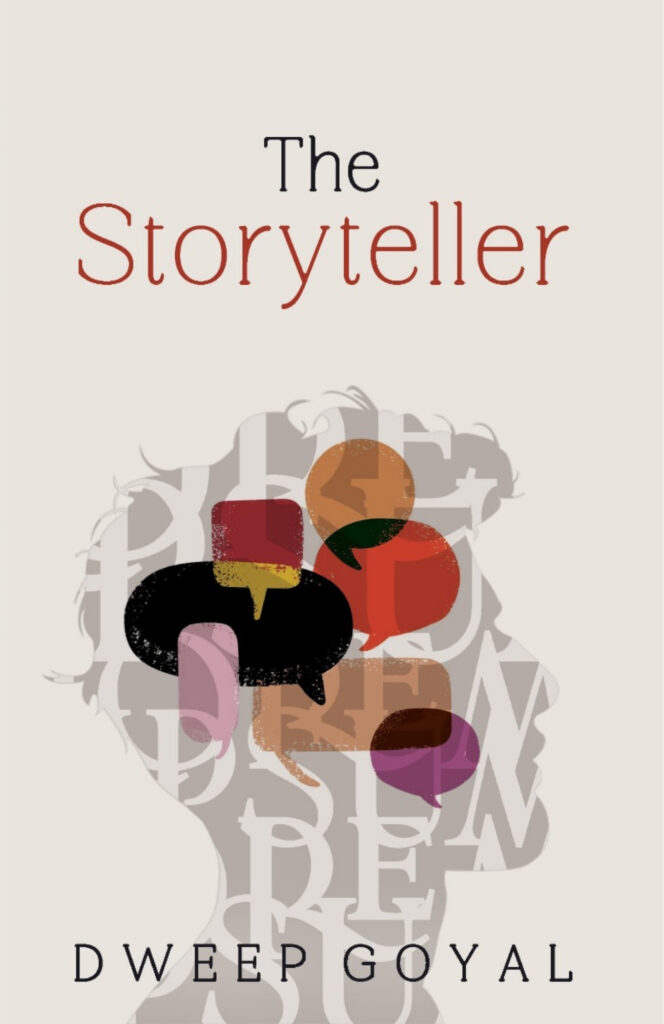
Some books tell stories. Others ask questions. And then there are books like The Storyteller, ones that quietly unsettle you, refusing to resolve, refusing to simplify, and most importantly, refusing to let you look away.
In this conversation with debut author Dweep Goyal, we explore a work that blurs the lines between allegory, prose poetry, and literary fiction. His writing doesn’t aim to comfort, it invites you to sit with ambiguity, to question what you think you understand about love, truth, power, and morality.
What follows is not just an interview, but a dialogue that mirrors the spirit of the book itself.
Q1. The Storyteller feels less like a traditional book, it blends allegory, prose poetry, and literary fiction, what first inspired you to structure it this way?
Honestly, I wasn’t trying to structure it at all. The stories came in the way they came, whether that was a poem, a prose piece, an allegory, a character study. Window became a poem-within-a-story because that’s how that particular thought lived in me. The Lost Letter needed to stretch into history because the emotion required that kind of distance. I didn’t sit down and decide on a form. I just followed wherever the idea wanted to go, and this is what came out.
” That instinctive approach really shows ,it feels less constructed and more discovered, like each piece found its own shape rather than being forced into one.”
Q2. Your stories explore love, truth, power, and morality in their rawest forms, why were you drawn to these particular themes?
Because they’re the things we think we understand until we actually sit with them. Everyone thinks they know what love is until they read A Moth and a Firefly and have to ask themselves: do I love the person, or do I love the longing? Everyone thinks they know what truth is until a mirror-maker dies for it and you wonder whether he was after truth at all, or just his own image. These themes kept pulling at me because they kept refusing to stay simple.
” That tension, between what we assume and what we uncover, is powerful. .”
Q3. Why did you choose not to provide clear resolutions in your stories?
Because the questions are the point. When I ended Imperfect with God going silent after being asked “And you?”… the silence is the answer. If I had resolved it, I would have taken something away from the reader. The same with The Lost Letter… the husband finds the letter after she’s already gone, and all he can do is laugh. There’s no lesson there, only the weight of what happened. I wanted people to carry that weight, not put it down.
“Choice of trusting the reader to sit with that weight of lingering emotions. It makes the experience far beyond the pages.”
Q4. How did your journey as a debut author, from shaping your manuscript to final publication unfold, and what role did publishing support play in shaping that experience?
There was a lot of self-doubt. The manuscript changed a lot as I understood what I was actually trying to say. I think Local Train was one of the last things that really clicked into place… the image of the reflection jumping off the train while the narrator just watches. Once that piece landed, the book felt complete. Publishing is its own kind of challenge, but I was careful not to lose the rawness in the process. Some of these pieces were uncomfortable to write. I didn’t want to smooth that discomfort out.
“Holding onto that rawness must have been difficult, but it is exactly what gives the book its edge.”
Q5. Do you think literature should challenge readers more than it reassures them?
Both have their place. But the books that stayed with me… the ones that actually changed how I think… were the uncomfortable ones. The Real Devil doesn’t let you place evil at a safe distance. Heaven doesn’t let you feel righteous about your goodness. I’m not interested in comfort for its own sake. That said, I don’t think challenge and comfort are always opposites. Sometimes a story is both at once.
” That balance is fascinating, stories that unsettle you, yet stay with you precisely .”
Q6. Recurring elements like mirrors, windows, gods, and devils create a symbolic landscape, what do these represent in your narrative universe?
They’re ways of getting at something that direct language can’t quite reach. The window in Window is about seeing versus being seen… and the irony that the narrator thinks he sees more than everyone else, only to realise he’s as caught in the glass as they are. The mirror is about the gap between who we are and who we want to believe we are. God in Imperfect isn’t really about religion… He’s about what happens to any of us when we love something so much that we lose perspective. The symbols are just entry points into those questions.
” It’s interesting how those symbols shift into something much more personal, and unsettling, the longer you sit with them.”
Q7. What was your writing process like for a book that feels so philosophical and introspective?
Unstructured. Genuinely. I wrote when something felt urgent. The Burning Paper came from thinking about what it would feel like to have your honesty monetized… that image of the paper burning itself in rebellion rather than becoming a commodity. Dissection Hall came from a question I couldn’t stop asking: what does evil actually look like under the surface? The process was basically: a question would arrive, and I’d write until the question felt honestly explored. Not answered. Just explored.
” That idea of writing toward exploration really defines the tone of the book, it feels like thinking in motion.”
Q8. Did any particular story or section challenge you more than the others?
Needs of a Woman, without question. Writing Rishika’s death… I had to be very precise about not making it tragic in a literary way, but making it feel like the ordinary, preventable thing it is. Same with Intoxication… the moment the narrator realizes he killed her. There’s a version of that which could feel like a dramatic reveal. I wanted it to feel like clarity arriving too late, which is a harder thing to write.
“ It feels less like fiction and more like something uncomfortably real.”
Q9. For aspiring writers, how do you approach writing stories that don’t aim to resolve but to provoke thought?
Don’t resolve things you don’t actually understand. If you’re genuinely confused about something, write toward the confusion, not away from it. Readers can feel the difference between a question that’s truly open and a question that’s been dressed up to look open. The storyteller’s job, I think, is just to be honest about where their understanding runs out.
“That’s rare advice, embracing uncertainty instead of trying to disguise it. It shifts the role of the writer from authority to observer.”
Q10. What kind of reader did you have in mind while writing this book?
In the Preface, I wrote that this book asks the reader to remain present… to observe without rushing to judgment. I think that’s who I was writing for. Someone who can sit with ambiguity. Someone who doesn’t need the mirror-maker to be right or wrong, the God in Imperfect to be villain or victim, the blind serial killer to be simply evil. Someone who can hold all of that without collapsing it into something easier.
” That kind of reader isn’t passive, they’re contributor in the experience, almost co-creating meaning alongside the text.”
The Storyteller doesn’t ask to be understood, it asks to be experienced.
In speaking with Dweep Goyal, what becomes clear is that this isn’t a book driven by answers, but by an insistence on honesty, on following questions to their limits, even when they lead to discomfort, silence, or contradiction.
For readers willing to engage with that uncertainty, the reward isn’t clarity, it’s recognition. A sense that the questions we avoid, the emotions we simplify, and the truths we think we know are far more fragile—and far more complex, than they seem.
And perhaps that’s the quiet power of The Storyteller: it doesn’t resolve the tension.
It leaves it with you.
Grab your Copies of “The Story Teller” by Dweep Goyal and explore the oceans of emotions.