














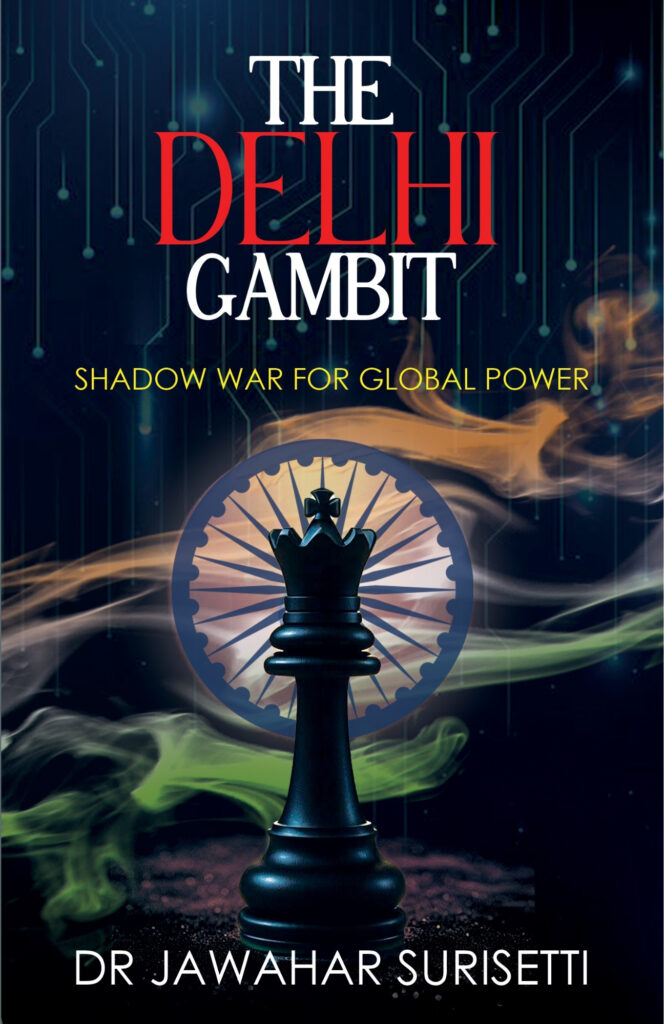
In an era where algorithms influence elections, narratives shape geopolitics, and data has become the world’s most valuable strategic asset, fiction is increasingly beginning to resemble reality. The Delhi Gambit – Shadow War for Global Power explores this shifting landscape through a gripping blend of geopolitical strategy, intelligence warfare, technology, and psychological influence.
In this exclusive conversation, we speak with the author about the inspirations behind the novel, the rise of invisible warfare, the relevance of ancient Indian strategic wisdom, and the growing battle between democracy and technological power structures. What emerges is not just the story behind a thriller, but a thought-provoking reflection on the future of global civilization itself.
1. What inspired you to write The Delhi Gambit – Shadow War for Global Power, and what drew you toward the world of geopolitical strategy and intelligence warfare?
The inspiration came from observing how the nature of power has changed in the 21st century. Earlier, nations fought wars with armies and weapons; today they fight with algorithms, narratives, data, economics, and influence. As someone deeply involved in policy, education, and futurism, I have had the opportunity to witness how invisible systems shape visible realities.
I wanted to write a story that combined the intensity of a geopolitical thriller with the realism of modern strategic conflicts. India stands at a fascinating point in history a civilization with ancient wisdom confronting a hyper-digital global order. That tension became the heart of The Delhi Gambit.
What drew me to intelligence warfare was the realization that the most dangerous wars are often the ones citizens never see. The battleground now exists inside minds, markets, and media ecosystems.
“That idea of “invisible systems shaping visible realities” is especially compelling in today’s hyperconnected world.”
2. What fascinated you most about the idea of a democracy challenging the dominance of global tech monopolies?
What fascinated me was the asymmetry of the battle. Democracies are messy, noisy, and accountable. Tech monopolies, on the other hand, possess immense concentration of data, behavioral intelligence, and financial power. In many ways, they influence societies more deeply than governments do.
The central question I explored was: Can democratic values survive in a world where algorithms shape public perception?
India became the ideal setting because it is perhaps the world’s largest democratic laboratory. It has scale, diversity, digital ambition, and a civilizational confidence that makes it capable of challenging entrenched global systems. The novel is not anti-technology; it is about reclaiming human agency within technological ecosystems.
“Your perspective makes the novel feel less like speculative fiction and more like an urgent conversation about where society is heading.”
3. The concept of the “Chanakya Protocol” is intriguing. How did ancient strategic wisdom become such an important pillar of the story?
I have always believed that civilizations survive because of strategic memory. Ancient India produced thinkers like Chanakya who understood statecraft, psychology, economics, espionage, and diplomacy centuries before modern geopolitical theory evolved.
The “Chanakya Protocol” in the novel symbolizes the fusion of ancient intelligence with modern systems thinking. Chanakya’s principles were never merely about conquest; they were about understanding human behavior, timing, perception, and survival.
In many ways, the book argues that India’s future strength will not come from copying the West or the East, but from integrating timeless wisdom with contemporary innovation.
“It’s fascinating how you frame ancient Indian strategic thought as relevant to modern geopolitics, blending civilizational wisdom with futuristic strategy to create a unique narrative identity.”
4. Do you believe modern warfare is shifting from battlefields to boardrooms, media narratives, and digital spaces?
Absolutely. Modern warfare has become multidimensional. Military power still matters, but the first strike today often happens through information manipulation, cyber disruption, financial leverage, or narrative engineering.
A stock market crash can destabilize a nation faster than a missile. A misinformation campaign can divide societies more effectively than an invading army. Data has become the new strategic resource.
The most powerful nations are now those that control ecosystems of communication, technology, finance, and perception. This silent warfare is more dangerous because most people do not even realize they are participants in it.”
“The idea that economies, narratives, and information ecosystems can destabilize nations more than conventional warfare is powerful and unsettling”
5. The book raises questions about control and perception. In your view, is power today more about influence than force?
Yes, influence has become the highest form of power. Force can compel action temporarily, but influence shapes belief systems permanently.
Today, if you can influence what people fear, desire, consume, or trust, you can influence entire societies. That is why platforms, narratives, entertainment, and information networks have become strategic assets.
The irony is that people often believe they are exercising freedom while unknowingly operating within carefully engineered psychological environments. This is one of the central tensions explored in the novel.
“That distinction between force and influence is striking.”
6. As a futurist and policy advisor, how did your professional experiences shape the realism and complexity of the story?
My professional journey exposed me to the intersections of governance, education, technology, economics, and human behavior. Real-world policy discussions are rarely simplistic; they involve competing interests, ethical ambiguities, hidden pressures, and unintended consequences.
That realism naturally entered the narrative. I wanted the story to feel plausible rather than fantastical. The characters operate in morally grey environments because the real world itself is increasingly grey.
As a futurist, I also spend considerable time analyzing emerging patterns. Many elements in the book are extrapolations of trends that are already visible today , AI influence systems, digital sovereignty, psychological targeting, and geopolitical data wars.
“ The world of the novel feels believable precisely because it mirrors the ethical ambiguities and competing pressures that exist in real policy and governance systems today.”
7. Your work often explores the human mind and decision-making. How did psychology influence the characters and conflicts in The Delhi Gambit – Shadow War for Global Power?
Psychology is central to every conflict in the book. Nations do not act emotionally, but people do and nations are ultimately driven by people.
I was particularly interested in cognitive bias, fear, ambition, loyalty, identity, and moral compromise. Every major character in the novel faces internal battles that mirror the external geopolitical conflict.
The most dangerous manipulations are psychological ones because they alter perception without appearing coercive. In the book, intelligence warfare is not only about spying on systems; it is about understanding vulnerabilities in the human mind.
“That psychological dimension gives the story emotional depth beyond geopolitical strategy alone.“
8. Was there a particular scene, strategy, or conversation in the book that you personally found the most powerful to write?
Yes. Without revealing spoilers, there is a moment where a senior strategist explains that “the greatest empires are built not by controlling territory, but by controlling imagination.”
That conversation was deeply meaningful to me because it captures the essence of the modern age. Civilizations rise or fall depending on the stories they tell themselves about identity, aspiration, and destiny.
I also enjoyed writing the strategic confrontations where silence, timing, and information asymmetry became more powerful than overt aggression. Those scenes reflect the subtle nature of contemporary power struggles.
“That line about controlling imagination rather than territory feels incredibly relevant to the modern age.”
9. If the novel leaves readers with one realization about global power and modern society, what would you want it to be?
I would want readers to realize that the future will belong to societies that can think independently.
Technology is not inherently liberating or dangerous; it depends on who controls it and how consciously citizens engage with it. Democracies must evolve beyond passive consumption and rediscover strategic awareness.
The novel ultimately asks readers to question who shapes their perceptions, who benefits from those perceptions, and whether humanity can preserve freedom in an age of invisible influence.
“Your answer elevates the novel beyond a geopolitical thriller into a reflection on freedom, awareness, and civic responsibility in the digital era.”
10. How has your experience been bringing The Delhi Gambit – Shadow War for Global Power to readers with Paper Towns India, and what has this journey meant to you as an author?
It has been an immensely rewarding journey. Working with Paper Towns India has allowed the book to reach readers who are intellectually curious about the future of power, technology, and society.
What has been especially gratifying is the diversity of reader responses. Some approach it as a geopolitical thriller, others as a commentary on modern civilization, and many see it as a warning about the future we are rapidly entering.
For me as an author, this journey has reaffirmed that storytelling remains one of the most powerful ways to engage people with complex ideas. Facts inform, but stories transform perception and perhaps that itself is the ultimate “Delhi Gambit.”
“That ability to spark thought through storytelling is what makes impactful fiction truly memorable.”
As our conversation comes to a close, one thing becomes clear: The Delhi Gambit – Shadow War for Global Power is more than a geopolitical thriller. It is a reflection of the rapidly changing architecture of modern power where information, psychology, technology, and perception increasingly define the future of nations and societies.
By weaving together strategic realism, civilizational philosophy, and contemporary global tensions, the novel challenges readers to think beyond headlines and question the invisible systems shaping everyday life. At its core, the story asks a deeply important question for the modern age: in a world driven by influence and engineered perception, can humanity still preserve independent thought and true freedom?
For readers drawn to geopolitical intrigue, strategic warfare, psychological complexity, and the future of global power, The Delhi Gambit promises not only suspense, but a conversation that lingers long after the final page.