














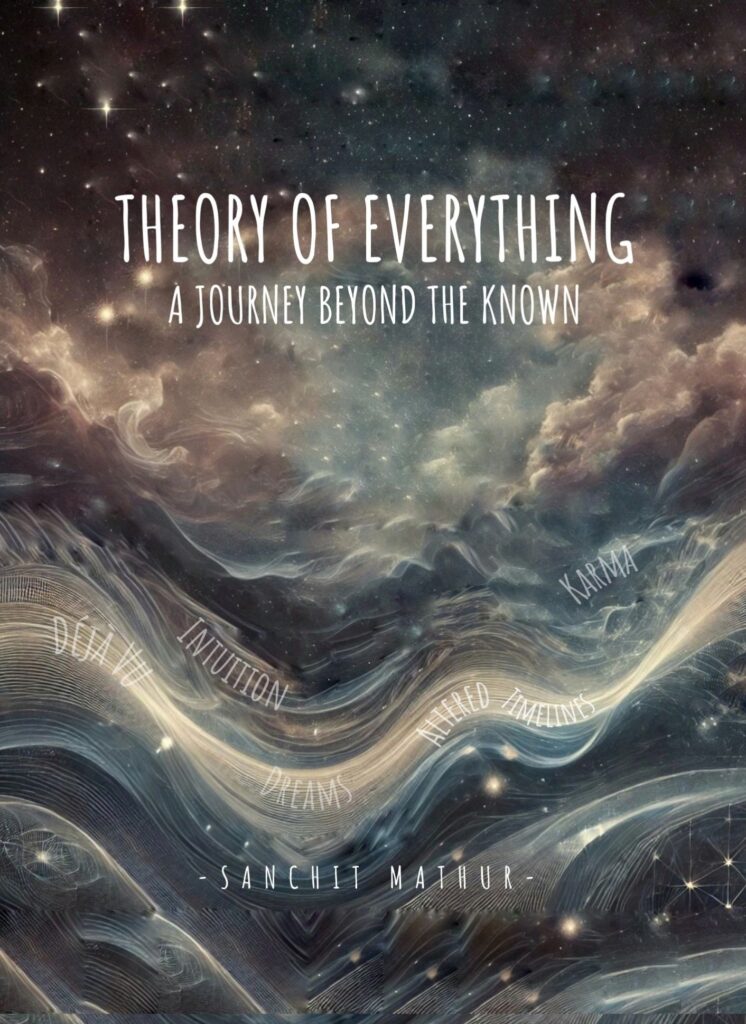
In a world driven by speed, distractions, and constant external noise, questions about consciousness, reality, purpose, and human experience often remain unexplored. Theory of Everything: A Journey Beyond the Known attempts to bridge that gap by bringing together ideas from science, spirituality, psychology, and personal observation into one thought-provoking journey.
In this exclusive conversation, the author opens up about the inspiration behind the book, the personal experiences that shaped it, and the deeper questions that led to years of research and reflection. From intuition and synchronicity to altered timelines and self-awareness, this discussion explores the intersection between the logical and the deeply personal offering readers a glimpse into both the book and the mind behind it.
1. The title is ambitious and intriguing- what does “Theory of Everything” mean in the context of your book?
My intent behind naming the book “Theory of Everything: A Journey Beyond the Known” was that it would explore and provide answers to almost everything I could imagine or deeply question about life, reality, the mind, and human experience. The book brings together research, theories, observations, and relatable examples to explain how many things in this world may actually work or function at a deeper level. That was the main idea and reason behind the title.
For me personally, the journey of researching and writing this book answered many questions I had been carrying for years. It helped me understand patterns, experiences, and aspects of life that once felt confusing or unexplained. And through this book, I genuinely hope readers are also able to find answers, clarity, and a deeper understanding of their own questions, struggles, and experiences – whether related to the mind, reality, purpose, or life itself at a more fundamental level.
“The title itself immediately sparks curiosity, and it’s fascinating to see how deeply personal experiences and universal questions shaped the foundation of the book.”
2. Your book bridges science, spirituality, and consciousness. What drew you to explore the intersection of these worlds?
I’ve always been fascinated by experiences that don’t fit neatly into one category; things like intuition, déjà vu, synchronicity, dreams, or moments where life feels strangely interconnected. Science often explains part of the picture, spirituality explores another part, and consciousness sits somewhere in between.
What drew me to this intersection was the realization that these worlds don’t necessarily oppose each other. In many ways, they complement each other. I wanted to create a space where curiosity could exist without rigid boundaries; where readers could explore deep ideas without feeling forced into either blind belief or complete skepticism.
“That balance between curiosity and openness really stands out.”
3. What core message do you hope readers carry with them after reading Theory of Everything?
More than anything, I hope readers come away with a deeper sense of awareness of themselves, their thoughts, their patterns, and the world around them.
We often move through life on autopilot, disconnected from intuition, meaning, and deeper reflection. If the book encourages someone to pause, question reality a little more deeply, trust their inner perception, or see their life from a broader perspective, then it has served its purpose.
I also hope readers realize that growth, purpose, and transformation are not distant concepts, they begin with awareness.
“Awareness as the starting point for transformation is a powerful message, especially in today’s fast-paced world where reflection often takes a backseat.”
4. How do you explain complex concepts like parallel realities and altered timelines in a way that feels accessible and meaningful to readers?
I tried to approach these concepts through relatable human experiences rather than abstract theory alone. Most people may not think in terms of “parallel realities,” but they do understand moments where one decision completely changes the direction of life.
Similarly, altered timelines can be understood through shifts in perspective, habits, relationships, or awareness. Small internal changes often create entirely different external outcomes. By grounding larger ideas in everyday experiences, the concepts become less intimidating and more personally meaningful.
I also made a conscious effort to explain every concept in very simple, easy-to-understand language so that even readers who are completely new to these subjects can follow along comfortably. Rather than making the book feel overly technical or philosophical, I wanted it to feel like a conversation. After discussing most theories or ideas, I’ve also included relatable examples and real-life scenarios to help readers connect the concepts to their own experiences and understand them more naturally.
“What makes these complex ideas approachable is the way they’re connected to everyday human experiences.”
5. Was there a personal experience or turning point that led you toward writing this book?
Yes, there absolutely was. There was a phase in my life where I began noticing a strange pattern – every time I gave my absolute best somewhere and finally started feeling comfortable or settled, something unexpected would happen and I’d suddenly find myself pushed into a completely different situation. For a long time, it felt frustrating and confusing. I couldn’t understand why things seemed to work only for a short period before falling apart or changing completely.
At the time, I saw it as failure or instability. But later, I began feeling that there had to be something deeper behind these patterns and experiences. That curiosity slowly turned into an obsession with understanding reality itself; why things happen the way they do, how certain events unfold, why some paths suddenly close while others unexpectedly open.
Even as a child, I’ve always been someone who constantly asks “why” and “how.” If I didn’t get satisfying answers from people around me, I would keep researching, reading, observing, and trying to understand things on my own until something finally clicked. So yes, the journey behind this book is deeply personal.
A combination of life experiences, inner questioning, and professional ups and downs pushed me towards exploring these ideas at a much deeper level.
” That honesty adds a very relatable dimension to the journey behind the book.”
6. Did researching and writing Theory of Everything change your own understanding of reality or self? If so, how?
Absolutely, it did. Researching and writing Theory of Everything changed the way I look at life, challenges, people, and even myself. As I started understanding these concepts more deeply, I slowly began to understand why certain things happened in my life the way they did, why some events repeated, why certain paths closed unexpectedly, and why others opened when I least expected them to.
Earlier, I would react emotionally to situations; questioning why things were happening to me, feeling frustrated, disappointed, or lost. But over time, my perspective shifted. Instead of constantly complaining or resisting situations, I started trying to understand the deeper reason and lesson behind them. That understanding brought a sense of calmness and clarity into my life.
Writing this book also made me realize how strongly our inner world shapes our outer experience. I became far more aware of patterns, thoughts, intuition, and the way perception influences reality. It taught me to observe life more consciously rather than react impulsively.
Now, even when I see someone else going through confusion or difficult phases, I naturally try to help them see things from a broader perspective. In many ways, this journey didn’t just help me write a book, it helped me understand myself better, discover my purpose, and find meaning in experiences I once struggled to make sense of.
” It’s clear that the writing process became transformative on a personal level as well.”
7. What has been the most challenging—and most rewarding—part of writing on such profound themes?
The most challenging part was finding data and details through which I could genuinely research these concepts and provide real insights that would help people actually understand and believe them. These are the kinds of topics that most people think about at some point in life, but very few truly try to understand how or why these things happen. People experience intuition, coincidences, patterns, déjà vu, or unexplained feelings, but they often stop at the experience itself instead of searching for deeper answers. So yes, researching and connecting all of this in a meaningful way was definitely challenging.
But once I truly started the journey, it almost felt like I was naturally being drawn toward the right paths, ideas, books, and experiences that slowly led me to those answers. The deeper I explored, the more things started making sense.
The most rewarding part is, of course, seeing all my hard work, curiosity, and research on topics I’ve been fascinated by throughout my life come together in one place in the form of a book. Now I not only understand these concepts better myself, but I can also help answer questions for people who are like me; people who constantly search for deeper meaning and want answers to the things they’ve always wondered about. And now, they can find many of those answers in one place.
And honestly, seeing my name on the cover of a published book feels amazing. It makes me feel proud, motivated, grateful, and reminds me that all the effort and persistence were worth it.
” It’s inspiring to hear how curiosity eventually evolved into clarity and purpose.”
8. Do you think modern life has disconnected people from their inner knowing? If so, how can they reconnect?
In many ways, yes. Modern life constantly pulls attention outwards; towards noise, speed, distraction, comparison, and endless stimulation. In that environment, intuition and inner reflection often get drowned out.
Reconnecting begins with slowing down. Spending time in silence, reflecting honestly, paying attention to recurring patterns, being present with thoughts rather than escaping them. These simple things can gradually rebuild that inner connection. I think many people already sense deeper truths within themselves; they just rarely give themselves the space to listen.
“That idea of “slowing down” feels especially relevant today. Sometimes the simplest practices like silence, reflection, and awareness can create the strongest connection with ourselves.”
9. Were there books, thinkers, or philosophies that significantly influenced your perspective while writing this work?
Yes, definitely. A lot of different ideas, philosophies, researchers, psychological perspectives, spiritual teachings, and scientific concepts influenced the way I approached this book. While writing, I explored subjects related to the subconscious mind, consciousness, human behavior, intuition, patterns in life, and the deeper connection between thought and reality.
At the same time, I didn’t want the book to simply repeat existing ideas. I wanted to understand them deeply, connect them meaningfully, and present them in a way that felt relatable and practical for readers. Wherever I’ve referred to concepts, quotes, or perspectives that came from other thinkers or sources, I’ve made sure to properly acknowledge and give them credit. So yes, many people, philosophies, and research sources have influenced and helped shape this book in different ways.
Along with external influences, personal experiences and observations also played a major role. In many ways, this book became a blend of curiosity, research, reflection, and my own journey of trying to understand life and reality more deeply.
“It’s refreshing to hear that the book blends both research and lived experience. “
10. How has your journey of bringing Theory of Everything to life with Paper Towns been, and what has this experience meant to you as an author?
Bringing Theory of Everything to life has been both exciting and deeply personal. Turning years of curiosity, research, experiences, and reflection into something tangible is an emotional experience in itself. Seeing an idea that once existed only in my thoughts become a real book that can now reach readers around the world feels incredibly fulfilling.
At the beginning, the journey was honestly quite challenging because I knew nothing about writing, publishing, or the overall process behind bringing a book to life. Everything was completely new to me. But throughout the process, I received guidance, support, and encouragement from the Paper Towns team, which helped me move forward with confidence and turn this vision into reality. Of course, there were many challenges and obstacles along the way, but together we were able to navigate through them and make it happen.
As an author, this journey has meant far more to me than simply publishing a book. It represents trusting my voice, my ideas, my experiences, and believing that these conversations about consciousness, purpose, reality, and the deeper aspects of life can genuinely resonate with people.
And honestly, this feels like just the beginning. I’m looking forward to reaching more readers globally, creating meaningful conversations, and spreading the knowledge, curiosity, and perspective this book carries to as many people as possible.
“Every author’s first publishing journey comes with challenges, and it’s inspiring to see how persistence, guidance, and belief in one’s ideas helped bring this vision to life”
Theory of Everything: A Journey Beyond the Known is more than just an exploration of theories or philosophical ideas — it is a reflection of curiosity, personal transformation, and the timeless human desire to understand life more deeply. Through this conversation, the author offers readers not only insight into the book’s themes, but also an honest look into the experiences and questions that inspired its creation.
By blending science, spirituality, consciousness, and personal observation into one narrative, the book invites readers to pause, reflect, and explore perspectives that often remain unexplored in everyday life. Whether one approaches these ideas with belief, skepticism, or simple curiosity, the conversation itself encourages deeper awareness and meaningful self-reflection.
As the author continues this journey, Theory of Everything promises to spark conversations that go beyond the surface — inviting readers to question, explore, and perhaps discover a new understanding of themselves and the world around them.
Grab your copies of Theory of Everything and expand your understanding of the universe.