














What does it take to transform a business from ₹8 crore to ₹82 crore? Is inventory simply stock sitting in a warehouse, or is it something much more fundamental to the health of a business?
For an entrepreneur who has spent a decade building, managing, and scaling a family business, these questions are not merely theoretical. They come from years of working with people, studying numbers, making mistakes, finding better systems, and understanding what truly drives a business forward.
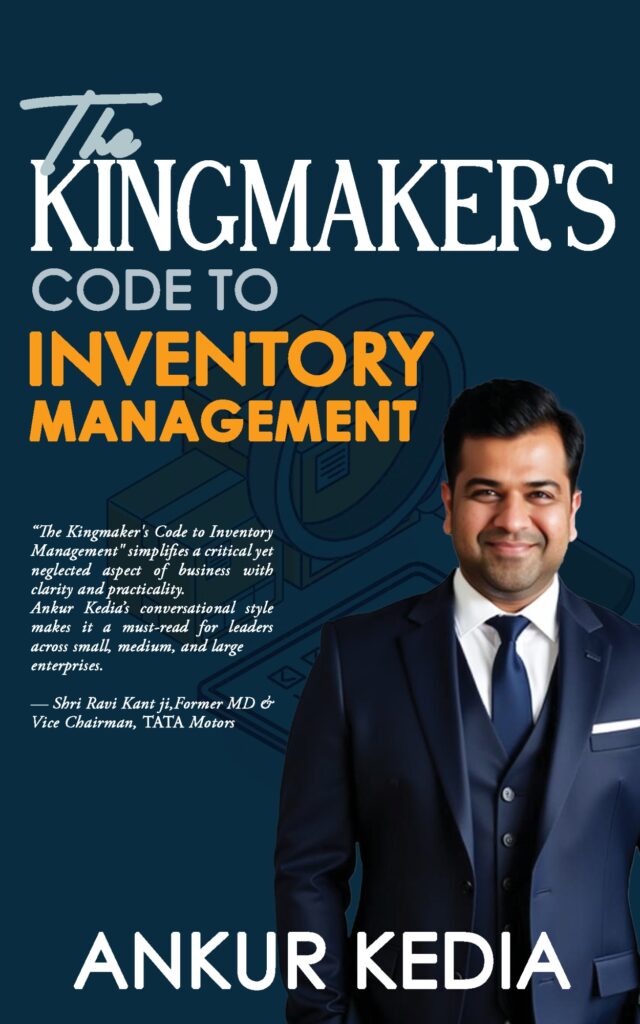
In “The Kingmaker’s Code to Inventory Management”, the author brings together these experiences to explore inventory management from a practical, real-world perspective. His journey has been one of significant personal and professional transformation from managing a small team and a single warehouse to building a much larger operation, while developing an inventory model that helped unlock capital and improve business performance.
In this conversation, he reflects on the inspiration behind the book, the lessons he learned while growing his business, why he considers inventory the “heartbeat” of an inventory-based business, and how data, systems, people, automation, and perspective can shape the future of an MSME.
He also shares real-life experiences from working with business owners, his vision for simplifying inventory management, and what he hopes readers take away from “The Kingmaker’s Code to Inventory Management”.
1. What inspired you to write The Kingmaker’s Code to Inventory Management?
Ans: What inspired me to write this book was the thought that I had completed ten years in my family business. And honestly, these ten years have taught me a lot… they helped me discover how I am as a businessman, understand myself better, understand the product better, and also understand what hard work really teaches you in the long run.
These ten years were not easy. They have transformed me as a human being. They changed the way I manage people, the way I get work done from team members, and even the dignity with which I look at my work. That is why I often use the words, “Work is worship.” It has been my WhatsApp status for as long as I can remember.
This journey also made me understand and value what I have been fortunate to receive because of the family I was born into… and that has humbled me a lot.
At the same time, the business also changed in a very big way. We grew from approximately ₹8 crore turnover to about ₹82 crore. Our team grew from around 3 people to nearly 25 people. We started with one warehouse and expanded to about 6 warehouses. The floor space we worked on increased almost 15 times. Initially, we did not have a single transport or logistics vehicle in our name, and eventually we had three.
Apart from all this, I also wanted to talk about the model that really transformed the business and gave a big boost to the way we work. Inventory management is something commerce students learn in school and college, but applying it in real life is completely different… somewhere down the line, that practical understanding vanishes.
The inventory model I learned from different business coaches, and then transformed into the King of IMS model, really helped us change the business. So, for me, the personal transformation, the business growth, and the development of this inventory model were the three major reasons that inspired me to write the book.
“Your answer brings together both a personal journey and a business transformation. Ten years of experience clearly seem to have shaped not just the book, but also the philosophy behind it.“
2. You describe inventory as the heartbeat of a business. What led you to this perspective?
Ans: There are many different forms of businesses. Some are service businesses and some are inventory businesses. Inventory businesses can further be manufacturing units, distribution houses, retail units, or simply trading businesses. So, in a very large number of businesses, inventory is involved.
In all these businesses, the revenue, gross profit, net profit… everything is connected with the price of the goods and the movement of the goods, either from the vendor to the business or from the business to the customer. Most of the money that comes into the business comes because of the goods that we possess and sell. That is why I feel inventory is actually the heartbeat of the business.
Especially because I come from the steel industry, where profit margins are very, very low and the room for making money is also low, I understood that the maximum amount of capital in the business is usually invested in inventory. In comparison, salaries and many of the other operating expenses are much lower than the amount of money blocked in stock.
After establishing the King of IMS model, we were able to shift our capital from the wrong SKUs towards the right SKUs. That brought in a lot of additional capital and profits. It made me understand that simply having more capital is not always the answer… optimizing the capital that is already there is the right thing to do.
In the human body, the heart supplies blood to every individual part of the body. In the same way, inventory affects every important part of an inventory-based business. That is why I have this perspective that inventory is the actual heartbeat of the business.
“That analogy makes inventory management feel much more fundamental than simply managing stock. It sounds like your own experience with capital and growth really helped you arrive at this perspective.”
3. If readers could remember just one lesson from the book, what would you want it to be?
Ans: A lot of people say that life is short… take quick decisions and move fast. I absolutely believe in taking quick decisions, and I am also a very decisive person by nature. But at the same time, I also believe that life is way too long. It is long enough to teach you the right lessons.
If you have good intentions and if you keep doing the right things, you will be rewarded in the right manner. But sometimes, when we build a business and achieve a few milestones that are well thought out and well deserved, we start slowing down in terms of innovation.
We sometimes stop thinking about how we can improve our work in a manner that makes our customers feel more valued than before… or how we can give them a lot more than what they were receiving earlier.
So, the one lesson I would want readers to remember is that we should always keep hunting for opportunities. We should keep our eyes open and keep improving our work, so that customers genuinely feel more valued because they are doing business with us. That is something I really believe in.
“I really like the emphasis on continuously looking for opportunities. It also connects strongly with the idea that business growth should not make us complacent, even after reaching important milestones.”
4. You successfully grew your own business from ₹8 crore to ₹82 crore. What were some of the biggest lessons from that journey?
Ans: There were a lot of lessons that I learned through my journey from ₹8 crore to ₹82 crore.
The first one, which I understood quite early, was that one should rely on facts and figures rather than the subjective perspectives of different people. Business is run on facts… it is run on numbers. So decisions should mostly be taken on the basis of numbers and not simply on what different people feel.
Another big lesson was that you should believe in people and invest time in building a good team. You, as an individual, can be an amazing performer, but you cannot build a business if you are 100% dependent only on yourself. Investing in the team really helps you take the business forward.
I also learned that inventory is genuinely the heartbeat of a business. Whether it is manufacturing, wholesale distribution, trading, or retail, a huge amount of money is invested in inventory. Managing it properly and keeping that money optimized is the key to running an efficient business.
Another lesson was that MSMEs can also implement innovation. As a small business owner, because of the people around you, you sometimes start feeling that growth is very difficult, the market is too competitive, systems cannot drive the business, and only hard work or continuously running around can help you grow. My own journey broke that perspective for me.
I also learned that we should automate everything that is possible, even if the automation is small. Business decisions should run on systems and not on specific people. These small automations help people plan better, reduce mistakes, and grow the business in a more organised manner.
And one of the biggest lessons I learned was that your perspective can help you build almost anything as a business owner. Your perception of the future, and what you believe is possible, matters a lot. If you genuinely think the business can become big, then yes… it can become big. There are opportunities, vendors, and customers. It depends on how you look at the market and how you decide to capture it.
“That journey seems to have taught you lessons far beyond inventory management from using data and building teams to automation and, perhaps most importantly, the mindset required to see possibilities that others may not see.”
5. How did your experience as an entrepreneur shape the advice you share in this book?
Ans: My journey as an entrepreneur is the reason I was able to experience all these things, discover this model, benefit from it, and see the changes that it brought into the operations of the business.
If I had not been an entrepreneur, I would probably not have had the opportunity to understand these perspectives, work so deeply on the inventory model, grow as a human being, and learn how to manage a business in a practical way.
So, the advice in this book is wholly and solely shaped by my entrepreneurial experience. I would say I dedicate this book 100% to the experience I have had as an entrepreneur.
“So, in many ways, the book is not simply a collection of business theories. It is an outcome of what you personally experienced, tested, implemented, and learned along the way.”
6. As an international business coach, what is the most common challenge your clients face when it comes to inventory?
Ans: When it comes to inventory, I feel that most businesses that suffer from inventory problems go through them because they have not properly analysed the sales data of the previous years.
Any inventory model that helps you foresee the future has to be built on a base of historical sales data… the sales of different SKUs across different timelines during the last one or two years.
I feel that business owners should start depending more on data analysis rather than their subjective perception of the market or their personal estimation of future demand. That would be one of the best moves they can make.
Funnily enough, a lot of people say that data analysis is the way to go and that they should study their data before taking business decisions. But in practicality, I feel more than 70–80% of businesses do not actually exercise it properly. That becomes one of the most common challenges during the implementation of an inventory model.
“That distinction between saying that we are data-driven and actually using data to make decisions is quite interesting. It seems that having access to data is one thing, but building the habit of actually analysing it is another.”
7. Are there other areas of business management you’d like to write about in the future?
Ans : Yes, absolutely. I am actually already in the process of writing another book, and that book is on hiring.
A lot of business owners have this complaint that they do not have the right employees or the right team to work with. I feel one of the major reasons is that they do not have the right hiring process installed in their company. If they concentrate on building the right hiring process, their suffering can reduce quite a lot, and they can get better team members for the company.
Apart from hiring, I would also love to write a book on accounts… especially on how MSMEs can simplify accounts, make small templates for their accounts team, and then proceed in a more structured way.
Another subject I would love to write about is MRM, which means Monthly Review Meeting. I strongly believe that monthly reviews can take you much, much further in business than only depending on personal perspective or judgement.
And if I have the time and the right support, I would also love to write a book on operations management… how simplifying operations, defining them through flowcharts, putting them on paper, and simply writing what needs to be done can help business owners get work done from their team members. I would like to write all of this from the perspective of a small company and mainly for MSME business owners.
“It sounds like inventory management is only one part of a much larger vision you have for helping MSMEs build better systems. Hiring, accounts, monthly reviews, and operations all seem to connect back to the same idea making businesses more structured and less dependent on individuals.”
8. Can you share a real-life success story where better inventory management completely transformed a business?
Ans:I now work with a lot of MSME business owners, where I help them set up this inventory model in their own businesses, clear stock, and transform the way the business works.
We are quite selective while taking on clients because we put in a lot of effort during the implementation. We feel that the process will not work properly if our core values and ethics do not match with those of the business owner. So, while we do love to take on new clients, we are very careful about who we work with.
One client we worked with was Meenu Sarees. We worked with them for around nine months on operations management as well as inventory management, and helped them create their own inventory module.
Through that module, they understood that out of the approximately ₹18 crore to ₹22 crore worth of inventory they usually kept, only around ₹12 crore to ₹12.5 crore was actually the right inventory. The remaining amount was excess inventory, as we define it through our model.
After identifying it and executing the stock-clearing process, we were able to free up almost ₹3.5 crore worth of inventory within about one year of starting the work with them.
This transformed the business in a very big way. Once they had additional cash available, they were able to make more cash purchases, reduce the credit they were taking from vendors, improve their purchases, and strengthen the overall cash flow.
It was a very important journey not only for them but for us also, because we were actually seeing the model getting developed and creating results in front of our own eyes. So yes… that was a very meaningful transformation for everyone involved.
“That is a powerful example because it shows the practical impact of inventory management. It is not simply about reducing stock it is about unlocking capital that can then be put back into the business in a much more productive way.”
9. What do you hope business owners feel after reading The Kingmaker’s Code to Inventory Management?
Ans: India has such a large population and it is also a country where MSME businesses play a very important role in the growth of the economy.
Within the MSME community, there is a common mindset that inventory is a big pain. Business owners know that inventory is what they purchase, sell, and use to run the business… but they still feel that managing it is painful. They feel it needs a lot of cost, systems, people, and constant attention.
I really want that perspective to break. I want people to feel that managing inventory is almost a no-brainer… it can be a very simple and normal thing, and inventory management can be exercised in a very simple manner.
I present myself as the Kingmaker because I want to give that freedom and confidence to every MSME owner that they can become the king of inventory management. I am no king of inventory management. Anybody in the world can become one, because it is actually a simple subject and it can be implemented well if people genuinely decide to do it.
That is the thought and the feeling I want business owners to have after reading the book.
“There is a very empowering thought at the heart of that answer—that inventory management does not have to remain a complicated or painful part of running an MSME. The idea of helping business owners become confident enough to become their own “Kingmakers” feels central to the book.”
10. How has your journey of bringing this book to readers with Paper Towns Publishers been, and what has the experience taught you as an author?
Ans : The journey with Paper Towns Publishers has been amazing. Through this process, I have really understood how simple it can be to actually publish a book when you have the right support.
I had been wanting to write a book for, I believe, around two and a half years. But because of Paper Towns, I was finally able to pen it down, put everything on paper, and actually take it to the readers.
I am genuinely grateful for this opportunity. Paper Towns has been very instrumental in helping me publish the book. As an author, the experience taught me that sometimes the idea may remain in your mind for a long time… but with the right people guiding you and pushing the process forward, it can finally become something real.
“And perhaps that is a fitting way to end the conversation with the journey from an idea that stayed in your mind for years to something that is now in the hands of readers. It also reflects one of the themes running through this entire conversation: the right systems and the right people can turn an idea into something real.“
From Experience to Impact
The story behind The Kingmaker’s Code to Inventory Management is ultimately a story about transformation.
It is about what ten years of entrepreneurship can teach you not only about business, but about people, systems, discipline, capital, growth, and yourself. From ₹8 crore to ₹82 crore, from one warehouse to six, and from a small team to a much larger organisation, the journey has been shaped by continuous learning and the willingness to question what can be done better.
At the heart of the conversation is a simple but powerful idea: inventory is not merely stock. For an inventory-based business, it is closely connected to capital, cash flow, profitability, and growth. When managed well, it can become one of the strongest levers available to an MSME business owner.
But perhaps the most important message is bigger than inventory itself. It is the belief that small businesses can innovate, build systems, use data, automate processes, invest in people, and create meaningful growth without losing the practical realities that make them unique.
With The Kingmaker’s Code to Inventory Management, the aim is not simply to share a model, but to make inventory management feel accessible, practical, and achievable for business owners.
Because, as the author puts it, the goal is not to be the king of inventory management it is to help every business owner become one.
Grab your copy of The Kingmaker’s Code to Inventory Management and unlock smarter ways to build and grow your business.