














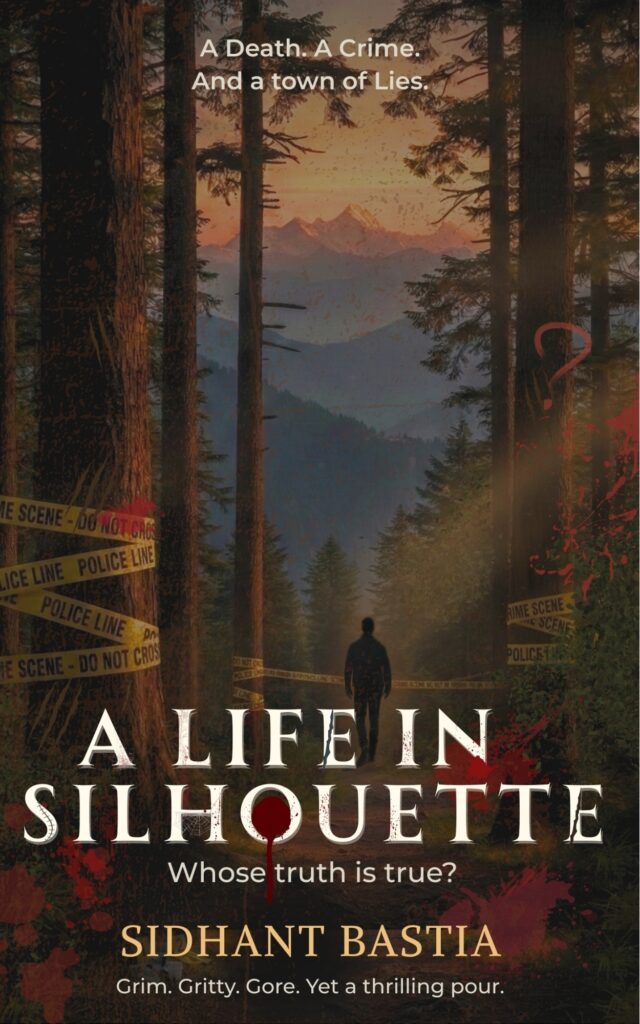
Stories set in serene landscapes often carry an unspoken promise of peace but what happens when that calm is shattered? Set in the quiet hill station of Chail, nestled in the breathtaking Himachal Pradesh, this gripping tale dives into the unsettling disruption of a seemingly ordinary morning by an unusual crime.
Blurring the lines between facts and fiction, suspicion and truth, the narrative unfolds like a psychological game where every character holds a piece of the puzzle, yet nothing seems entirely reliable.
In this exclusive conversation, we sit down with the author, Sidhant, a storyteller who finds inspiration in the hidden corners of the world.Let’s explore the mind behind this dark, intriguing story.
Q1. What inspired you to choose Chail as the backdrop for this story?
When I started to envision the story and decided to set the premise, I always knew I had to go for a hill station.The story being set in the 90’s era, I had to find suitable place which had less significance for tourists and was not fully explored back then. After a through research I zeroed in on Chail, as in the 90’s it was still a place being discovered by the rest of the world where as it had palaces, a vast history and a rich heritage which make the inhabitants proud till date. And I think many other factors too influenced my decision to go with Chail as there was mountains around with creeks to explore as well as river Setluj in the periphery. Eventually giving me the liberty to explore and fall back on the flora and fauna of the beautiful Chail.
That’s fascinating choosing a setting that itself feels like a character adds so much depth to the story.
Q2.How does the setting of Himachal Pradesh influence the mood and narrative of the book?
Himachal Pradesh is known as the “Abode of Gods”. It has every thing to enamour a person and engulf us with its landscapes, culture, traditions and most importantly the people. So setting the story in Himachal Pradesh naturally brings in a calm, slow paced, peaceful environment into the scene. To picture a crime thriller in this environment was fascinating for me and I couldn’t resist the greed of baffling something so serene with a heinous act of crime to see how it goes.
The contrast you describe already builds a strong sense of intrigue it makes the crime feel even more unsettling.
Q3.The contrast between a peaceful hill station and sudden chaos is striking ,was this intentional?
Certainly it was!!! It was the wild in me that made me do it. A city facing a grave crime and chaos is so unfortunately common to hear now. Every day we can be assured of learning about an unlawful act being conducted in the busiest of the places. Towns, cities or say the big world we live in has no place for emotional connect anymore. Deceitful and vague ideology has taken over. But the only places we still go to escape the chaos is places like “Chail” which are away from these commotions. And to see something so criminal happen in a place which is usually a “get away destination” for people is so sad and exhausting in general. So I tried to ideate the story around that vision.
That intention really adds a psychological edge turning a safe haven into a place of uncertainty.
Q4. The story revolves around an “unusual crime” what makes this crime different from typical thrillers?
The Idea that a place so quite, shy and small like “Chail” where people are closely knit and have very little to tell yet so much to give, is taken aback by a crime which had never ever happened around them making it an unusual crime. A crime which seems like one and is not. A crime which cannot be adjudged as crime of passion or a well determined one. Small town vibes helps in spreading the word and with that the rumours and different narratives go around hence changing perspectives. The nature of the crime keeps changing as the story unfolds and leaves the readers guessing. This makes the act an “Unusual Crime”.
That evolving nature of the crime sounds like it keeps readers constantly questioning what they believe.
Q5. Is the crime driven more by emotion or calculation, according to your perspective?
If I am asked to explain about the crime in the story, I would rather not dive into it and keep it for the readers to explore but in general I do have a say. Crime of any kind should be met by the hands of the law. Emotion driven or a calculated act of crime doesn’t make a difference in the end if it hampers any other being. A wrong cannot ever be right, even if it is driven by emotions or so calculated that it looks righteous.
That’s a powerful stance it shifts the focus from justification to accountability.
Q6. The phrase “facts and fairy tales play checkers” is very intriguing , can you elaborate on this idea?
The story revolves around a crime whose nature keeps changing over the period of time as the story unfolds. Facts and evidences don’t bring in a stable conclusion as each person has it’s own anecdote and a version of the events. Assumptions, guesses and wild theories build various fairly tales tossing the facts and truth into a tumultuous ride here. It’s a game of hide and seek with checkered strategies is all I can say here.
That metaphor really captures the uncertainty and layered storytelling you’re aiming for.
Q7. What does “everyone being a suspect with their own anecdote” add to the reader’s experience?
Chail is a small hill station and people who live there know each other in and out. And the characters in this story are no different. When each one of them have a side to the story it makes every one questionable. The credibility goes for a toss and the only thing that lurks in is suspicion, doubts and accusations.
That kind of narrative must keep readers constantly on edge, unsure of whom to trust.
Q8. Does the book explore the idea of truth being subjective?
The truth can never be different but can be looked through different angles to debate on how justified it was. But a fake narrative will have versions and different sides to it because it’s baseless and built on emptiness. I do believe truth can be modified as per preference so yes at times truth can be subjective to situations, circumstances and time.
That philosophical angle adds depth beyond just the thriller element.
Q9. What was the most challenging part of writing a layered mystery like this?
Writing a mystery thriller is definitely challenging in various ways. I cannot decide where to start with, be it setting a premise leading to the event or deciding the event which should be so happening that you can revolve around it with all your characters and build a world of your own. Keeping your readers engaged and the tempo of the book high and rising is important. Thrillers I believe cannot be a slow burner. It has to be engaging and twisted to keep a question mark lurking always.
Maintaining that pace while building complexity is definitely no small feat.
Q10. Which character was the most complex for you to write and why?
I wouldn’t say I found any character complex to write. As an author I knew where I was heading with the characters and story. I had conviction on delivering the desired behaviour to the characters to put life into them. But one character I was very cautious while writing about was “Raina”. Because her story spans over decades to and forth, where as the whole books is about 7 days only. Other characters have depth, history and even future but the dark horse for me was “Raina”.She is calm, composed, classy, controlling, giving, sacrificing, kind yet compelling while having a hidden side to her. I am eager for readers to find her and know her.
Raina sounds like a truly layered character definitely someone readers will be curious about.
Q11. If your book had to be described in one emotion, what would it be?
Deep, dark, gritty, grime, thrilling and Fun. The story has characters who show different characteristics and build the scenes on their own. “A life in Silhouette” will bring smiles, adventure, adrenaline and thrill into the readers as it’s a thrives on different emotions and characters of the story.
That mix of emotions makes the experience feel dynamic and immersive.
Q12. how would you describe your journey from manuscript to publication, and how did the support you received along the way shape your overall experience?
It takes time to create and ideate a story. Takes more time to write it and decorate it with premise, characters, relations, events and a suitable ending. To string them and present it in a platter is an art. The platter decides if a book is going to get a reader. Papertowns sets the platter well and thus I have trusted them with my second novel. Dedicated teams and transparent conversations helps in building trust. As an author I look for comfort and trust after handing over my manuscript. Paper towns takes care of my hard labour and has certainly executed the deliverables really well till date.
It’s great to hear how the right support system can enhance an author’s journey and bring their vision to life.
“A Life in Silhouette” promises to be more than just a crime thriller it’s a layered exploration of perception, truth, and human nature set against the tranquil yet mysterious backdrop of Chail.
Through this conversation, Sidhant gives us a glimpse into the thought, intention, and complexity behind his work. As readers, we are invited not just to follow a story, but to question every perspective, every narrative, and every truth presented.
If you enjoy stories that keep you guessing while immersing you in rich atmospheres and layered characters, this might just be your next compelling read.
Grab your piece of the mystery thriller ” A life in silhouette ”