













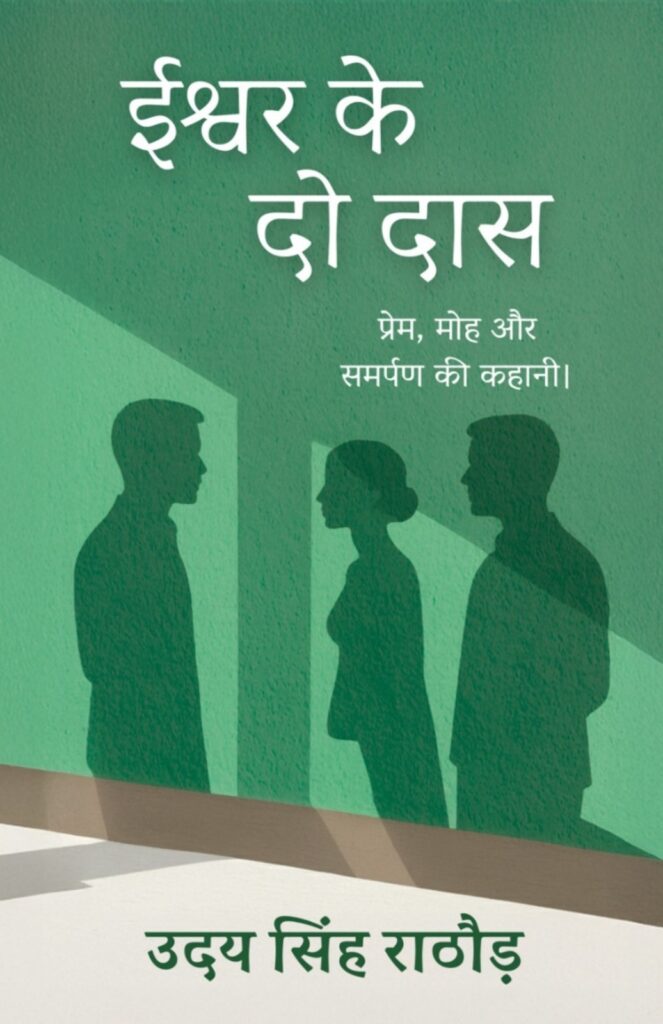
In contemporary Hindi literature, where emotional depth often struggles to find new expression, ‘ईश्वर के दो दास’ emerges as a refreshing voice. Blending psychological realism with modern sensibilities, the novel unfolds the story of three souls- Siddharth, Anurag, and Ihita.
“तीन लोग, तीन चाहतें… और एक जाल—प्यार और दोस्ती का।”
At its heart, the story explores innocence, emotional complexity, and the fragile intersections of love and friendship. Siddharth, deeply introspective; Ihita, delicate yet caught in emotional crosscurrents; and Anurag, simple yet driven by desire, together form a narrative that feels both intimate and universal.
In this conversation, the author reflects on the journey of writing this evocative novel, sharing insights into emotions, storytelling, and the quiet philosophy that shapes the narrative.
1. What drew you toward writing a coming-of-age story at this point in your literary journey?
Just before I began writing ‘Ishwar Ke Do Daas’, I felt a strong urge to write characters who were essentially clean at heart, yet capable of making a few innocent mistakes, the kind we often make in real life. And just like in reality, where we never truly know the consequences of our actions in advance, I wanted neither myself nor my characters to know what awaited us ten pages later.
This desire naturally pulled the story into that particular age of life, an age where mistakes are not born out of ill intent, but out of innocence itself.
” It’s interesting how the author embraces uncertainty, not just as a theme, but as a creative process itself.”
2. The novel feels rooted in contemporary sensibilities. How did you balance modern emotions with the traditional depth of Hindi storytelling?
To be honest, this question kept returning to my mind again and again while I was writing the story. At times, it felt like I had abandoned literature altogether and was simply writing conversations; at other times, it felt as though, in my pursuit of literary depth, I was leaving contemporary emotions behind somewhere along the way. I believe it was this constant questioning of myself that ultimately maintained the balance.
As a writer, I try to let my choice of language, its beauty or its traditional weight, remain largely within the narration. When my characters speak or express an emotion, I want them to feel rooted in their own time, exactly as they are meant to be.
” That tension between tradition and modernity seems to have shaped the narrative in a very organic way.”
3. The title Ishwar Ke Do Daas has philosophical undertones. What role does destiny or choice play in the lives of your characters?
Personally, I believe that our desires shape our destiny, and our destiny, in turn, shapes our desires, as if there is a subtle, ongoing interplay between the two, moving forward in quiet coordination. This way of thinking naturally flows into my characters as well.
At times, they move according to their own will; at other times, destiny pulls them in an entirely different direction. Sometimes they change their fate through choice, and sometimes fate itself awakens the very desire within them that becomes their destiny.
“The interplay between fate and free will adds a philosophical depth that resonates beyond the story.”
4. Many readers may see reflections of their own youth in this story. How much of the novel is influenced by real-life observations?
Perhaps, on an emotional level, quite deeply. It is possible that readers may not always see themselves in the specific decisions or events of the story, but within the emotions, they will almost certainly recognize an echo of their own experiences. As a writer, I too see this novel as a reflection of my own emotional journey.
And the reason for this is quite simple: the reasons why we touch ice or fire may differ from person to person, but what we feel upon touching them is almost the same for all of us. In much the same way, I believe that what differs in our lives are the decisions and the events, but not the emotions they give rise to.
“This universality of emotions is perhaps what makes the story so relatable.”
5. From preparing the manuscript to seeing the novel reach its audience, how would you describe the overall publishing journey of this book?
Completing a book and then watching it find its way into the hands of readers is always an exhilarating experience. For me too, this journey was filled with a mix of nervousness and excitement. There were moments when waiting and restlessness took over. But by the time I reached the end of this story, one of the things I had learned was that there is often more joy in watching things unfold than in trying to control them. So I chose to witness the entire journey with patience, and that, in itself, carried a quiet thrill of its own.
“The idea of “letting go” seems to mirror the emotional arc of the book itself.”
6. Now that the book has been launched, how do you hope readers emotionally connect with the story long after finishing it?
I hope that readers experience something similar to what I felt after writing the final line of the book, those few days of living with a quiet smile, simply watching things settle into place. And even if that smile is small or large, or if instead of a smile it takes the form of a subtle ache or a gentle sting somewhere within, I believe this story will bring all of us to the same depth of emotional awareness.
” It’s rare for a story to aim not just for impact, but for a lingering emotional presence.”
7. Can you describe your overall writing process… and the challenges you faced?
In truth, I don’t have a fixed process. So far, every one of my stories has begun with an attempt to express a single emotion, and that, in many ways, becomes my greatest challenge as well. Stories demand time, but an emotion does not stay within us for very long.
Often, the story begins to ask for a new emotion in order to move forward, while I remain mentally stuck in an entirely different one. Like every writer, this is when the words stop coming. For days at a stretch, the only sight in front of my eyes is the blank white screen of my laptop.
After such phases, sometimes patience wins, and creativity returns to carry the story ahead. At other times, I find myself drifting toward an entirely different story altogether. But because I haven’t yet decided whether I want to be a one-book writer or a fifty-book writer, or whether I want to write a single perfect book or ten reasonably good ones, I am ultimately able to find joy in both outcomes.
” This honest reflection on creative struggle adds a human layer to the craft of writing.”
8. How do you usually approach building characters and emotional depth within a story?
There is an unspoken formula in my mind (at least for now). According to it, whatever my characters are feeling should remain as closely tied to reality as possible, firmly anchored in real life. But when it comes to how they respond, I try to amplify it five, ten, even twenty-five times over, however much feels right. Their reactions are allowed to become as imaginative as they need to be.
That’s really it. In real life, we tend to restrain our reactions, expressing them carefully, within set boundaries. Stories shouldn’t do that. It is this unrestrained expression that ultimately transforms feeling into art.
” That balance between realism and exaggeration is what gives it the emotional intensity.”
9. What role do observation and real-life experiences play in shaping your writing?
I believe that not just in writing, but in every art form, an artist’s observations of the real world and their lived experiences play a vital role. My writing is no exception.
Ultimately, whatever we live through in reality settles somewhere within us, and it is from that very place that art is born. My writing, too, comes into being carrying a reflection of my own experiences.
“It reinforces the idea that storytelling is, at its core, deeply personal.”
10. After this launch, how do you see your writing journey moving forward?
I want to relive everything I have experienced from the very first word of Ishwar Ke Daas to the moment the book was published. But this time, with greater depth, greater uncertainty, and greater excitement.
“A journey that continues to evolve, much like the themes of the book itself.“
11. Anything you would like to say to your readers…?
I would simply like to say that, like all my stories, Ishwar Ke Do Daas was not written to arrive at a conclusion or to offer fixed answers. I only tried to place a few emotions before the reader with honesty.
So if you picked up Ishwar Ke Do Daas with a hope, a question, or a quiet search within you, I would wish that hope, that question, or that search stays with you even after the book comes to an end. Because, ultimately, life is more a journey than a destination, and to keep a journey alive, a certain sense of uncertainty is essential.
I would also hope that the relationship between us, as writer and reader, always remains a journey, always alive, always exciting, and always uncertain. My heartfelt gratitude to you all.
“A thoughtful and fitting message that beautifully captures the spirit of the book.”
‘ईश्वर के दो दास’ is not just a story, it is an emotional exploration that lingers beyond its final page. Through this conversation, the author reveals a creative process rooted in honesty, uncertainty, and deep emotional awareness.
In a world that often seeks clear answers, this novel invites readers to sit with questions, to feel deeply, and to embrace the beauty of not knowing. And perhaps, that is where its true power lies.
Grab your copies now , as some stories are to be experienced through a readers lens :-