













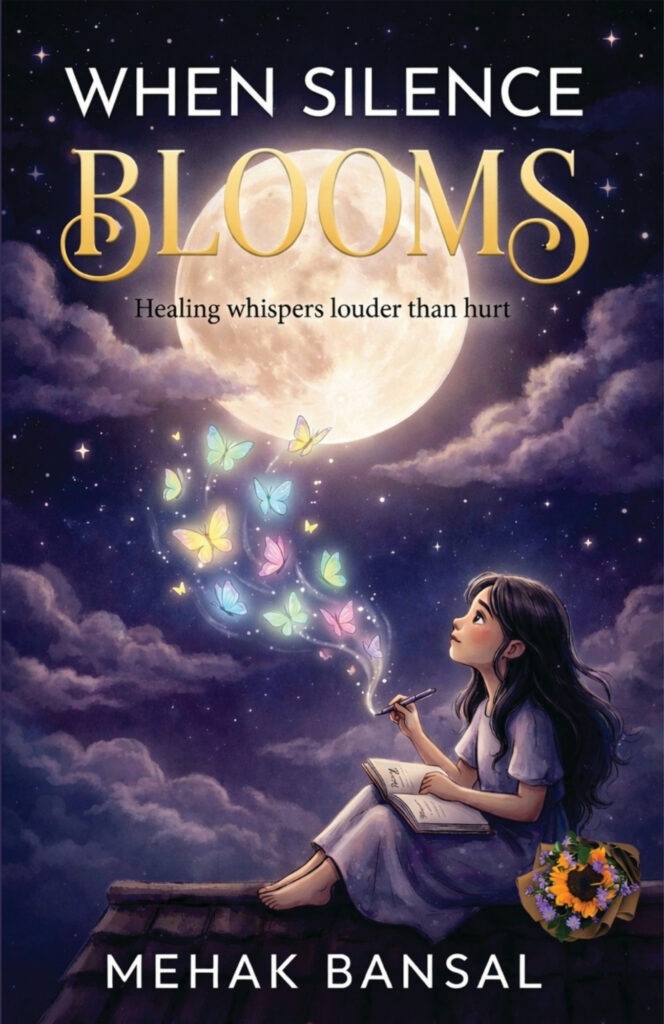
Some conversations don’t arrive loudly they unfold gently, much like poetry itself. In this intimate interaction, we explore the journey of a poet who finds meaning not in grand declarations, but in quiet reflections and unspoken emotions. From discovering the power of words in school to shaping a collection rooted in healing and introspection, this conversation offers a glimpse into how poetry becomes both an outlet and a mirror.
What stands out most is the honesty an understanding that emotions don’t always need to be loud to be profound. Sometimes, they simply bloom in whispers.
1. When did you first discover your connection with poetry, and what inspired you to write this collection?
My connection with poetry began in the 8th standard. At that time, one of my teachers nudged me and encouraged me to move towards creative writing. That was the moment when I truly realised the power of words. I came to believe very strongly that words are powerful and can express emotions in ways that conversation sometimes cannot.
Initially, I was quite hesitant and shy about writing. I would write just two lines, three lines, or sometimes four lines. Gradually, with time, I started writing more. I noticed that whenever my emotions felt too complex to explain to someone, I would naturally turn to writing. That is when I realised that poetry allows us to capture moments, thoughts, and silences that we often cannot fully express while speaking.
The inspiration behind this collection came from those quiet reflections as well as spontaneous moments of emotion. Sometimes I would write instantly when I was feeling something very deeply. At other times, I would note down my feelings and later go back, sit with them, reflect on them, and then write. So the poems in this collection were written both during moments of introspection and spontaneous emotional experiences.
For me, emotions are not always loud or dramatic. Often they are soft and lingering. This collection is inspired by the idea that people sometimes do not truly believe in healing. When they feel hurt or broken, they often expect themselves to move on quickly. But healing does not work that way.
Healing takes time. It is a slow and quiet process. It happens in the small spaces where we sit with our feelings instead of running away from them, where we acknowledge them, accept them, and allow ourselves to embrace our emotions.
“It’s fascinating how poetry became less of a skill and more of a refuge, a space where emotions could exist freely without explanation.
2. Your book begins with the beautiful idea that “some feelings bloom in whispers.” What drew you to explore the quieter side of emotions rather than louder expressions of them?
I have always been a very introverted and reserved person. Even during my classes, there were many moments when I had thoughts in my mind, but I did not speak much because of my reserved nature.
When I discovered poetry, I realised that I was deeply fascinated by the emotions that remain unspoken; the ones that quietly stay in the corners of our hearts. We live with those emotions every day, even if we never express them openly.
Not every emotion enters our lives like a storm or a tornado. Sometimes emotions simply sit with us, travel with us, and exist quietly within us. They unfold gently and almost silently, like something blooming without noise.
For me, feelings do not always need loudness. Some feelings bloom in whispers. Sometimes, even a quiet space, a single word, or a single line can express much more than louder expressions.
Exploring this quieter side of emotions felt very personal to me because in everyone’s life, there comes a turning point. There are moments or incidents – sometimes internal, sometimes external, sometimes visible and sometimes invisible – that change our lives.
In those moments, we often become silent observers. That silence holds many things within it, like grief, healing, understanding, and even hope. Even when life feels like it is falling apart, we continue to survive because of hope. For me, hope feels like a dangling thread that we continue to hold on to.
Through this collection, I wanted to create space for those softer emotional landscapes that people often overlook.
“There’s something deeply moving about the idea that not all emotions demand attention, some simply ask to be felt.”
3. This collection feels very intimate and reflective. Did writing these poems change the way you understand your own emotions?
Yes, definitely. Writing these poems made me meet myself more deeply.
Poetry has a way of slowing you down. Sometimes I wrote spontaneously in the moment, but many times the process made me sit, think, feel, and reflect on my experiences. It forced me to sit with what I was feeling rather than pushing it aside.
While writing this collection, I realised that emotions are rarely simple or singular. They are often complex. They overlap, evolve, and sometimes contradict each other.
There is a line in Hindi that expresses this feeling beautifully:
Kashmakash khud se hai, tabhi to lagta hai sabse hai.
It means that the struggle is actually within ourselves, yet it often feels as if it is with the whole world.
I have also written about how we carry two inner truths within us that pull our souls in opposite directions. Writing about those moments helped me understand myself better. The process of putting emotions into words helped me handle each emotion more gently.
What we often call negative emotions are not really problems that need to be solved immediately. They are experiences that shape us and help us grow.
““the struggle is actually within ourselves” – It’s powerful how writing didn’t just express emotions but helped untangle them, almost like a quiet form of self-therapy.”
4. Do you usually write spontaneously when inspiration strikes, or do you return to certain emotions over time until they form into poetry?
For me, it is a combination of both.
Sometimes I write instantly when I am feeling something strongly. I keep writing and allow my raw emotions to flow onto the page.
At other times, the process is slower. I may observe something or experience something that stays with me. I go back, sit with those feelings, reflect on them, and then try to articulate them into poetry.
Sometimes a single line or an image appears suddenly in my mind, and I write it down instinctively. Other times, I stay with a feeling for a long time before putting it into words. Many poems in this collection came from emotions that linger quietly in the background of everyday life.
“The balance between spontaneity and reflection feels very real.“
5. Is there a poem in the book that feels especially close to your heart or represents the soul of the collection?
Every poem in this book is very close to my heart. I still remember the context behind each poem; what I was feeling and what experiences led me to write it.
The opening lines of the book are very special to me:
“The inner conflict feels like it’s within someone, yet somehow it seems to dwell within
everyone.”
These lines reflect something I deeply believe: often, the struggles we think we have with the outside world are actually struggles within ourselves.
I also wrote a piece about faith that is very dear to me:
A whispered prayer can move what our hands cannot.
Faith, when released into the world, returns as quiet miracles.
I strongly believe in prayers. For me, praying with a true heart can create miracles. Whispering a prayer with complete faith can slowly transform our lives.
If I had to describe the soul of the collection, it would be the poems that talk about healing through quiet acceptance, learning to sit with pain without letting it define you.
“The idea of faith as something soft yet powerful adds another layer to the collection.”
6. If readers could take away one feeling or thought from this book, what would you want it to be?
I would want readers to remember one simple thing: be gentle with yourself.
Often, in the name of “letting go,” we try to suppress our emotions completely. In that process, we sometimes lose a part of ourselves. We expect ourselves to heal quickly or appear stronger than we actually feel.
But healing is not a quick process. It takes time, and during that time, it slowly shapes us. If this book leaves readers with anything, I hope it reminds them that it is okay to move slowly through emotions. Even the quietest forms of healing are meaningful.
“Be gentle with yourself” feels less like advice and more like a quiet reminder we all need.”
7. When you look back at this collection now, do you see it more as a record of emotions, a form of self-understanding, or something else entirely?
When I revisit this book, I feel that poetry often changes meaning depending on the reader’s experience and emotional state.
Even for me, when I re-read my own poems at different points in time, I sometimes interpret them differently.
For me, this collection feels both like a record of emotions and a journey of self-understanding. Each poem captures a particular moment in time or a certain emotional experience.
Together, they form a reflection on growth, vulnerability, and healing. Looking back, the collection feels almost like a quiet conversation with different versions of myself.
“The idea of poetry as an evolving conversation with oneself is striking.”
8. Are there themes in this book that you feel will resonate differently with readers depending on where they are in life?
Yes, absolutely. Poetry often changes meaning depending on the reader’s experience and emotional state.
A poem about silence might feel comforting to one reader, deeply reflective to another, or even painful to someone who feels completely seen in those lines.
Themes like healing, loneliness, resilience, quiet self-discovery, and love resonate differently depending on the stage of life someone is in.
Often, people assume poems about loneliness or heartbreak are only about romantic relationships. But those emotions can arise from many aspects of life, such as academics, career struggles, family, friendships, or even personal isolation.
“This really highlights the beauty of poetry- it meets the reader where they are. The same lines can comfort one person and deeply stir another.“
9. If a reader were to sit with this book slowly, perhaps returning to it over time, what kind of experience would you hope it offers them?
Sometimes during the first reading, the poems may even create a sense of emotional chaos. This happens because we often do not acknowledge our emotions fully.
But if a reader returns to the book again, maybe a second or third time, I hope it begins to feel like a calm and reflective space.
Ideally, the experience should feel less like reading a structured narrative and more like sitting with a series of gentle thoughts.
“I love the idea of a book transforming from emotional chaos into calm.”
10. Finally, what would you say to someone who relates deeply to poetry but struggles to put their own emotions into words?
I would tell them that writing does not have to begin with perfection. Even when I started writing, my poems were very simple.
Poetry does not always require fancy words or complicated language. Sometimes all it takes is a single line, an image, an emotion, or even a fragment of a thought.
If you feel something deeply, you have already done half of the work of writing.
The rest is simply giving yourself the patience to sit with those emotions and explore them.
“The reminder that poetry doesn’t need perfection lowers the barrier for anyone who’s hesitant to begin.”
This conversation doesn’t just explore poetry—it embodies it. There’s a quiet honesty running through every answer, reminding us that emotions don’t need to be loud to be meaningful. In a world that often rushes healing and glorifies strength, this perspective invites us to slow down, to sit with ourselves, and to embrace the softer edges of our experiences.
Perhaps the most lasting takeaway is simple yet profound: not everything needs to be spoken loudly to be deeply felt. Some of the most important parts of us exist in whispers and that is where poetry begins.
Find the link of this amazing book where emotional calm and chaos are wrapped into one.