











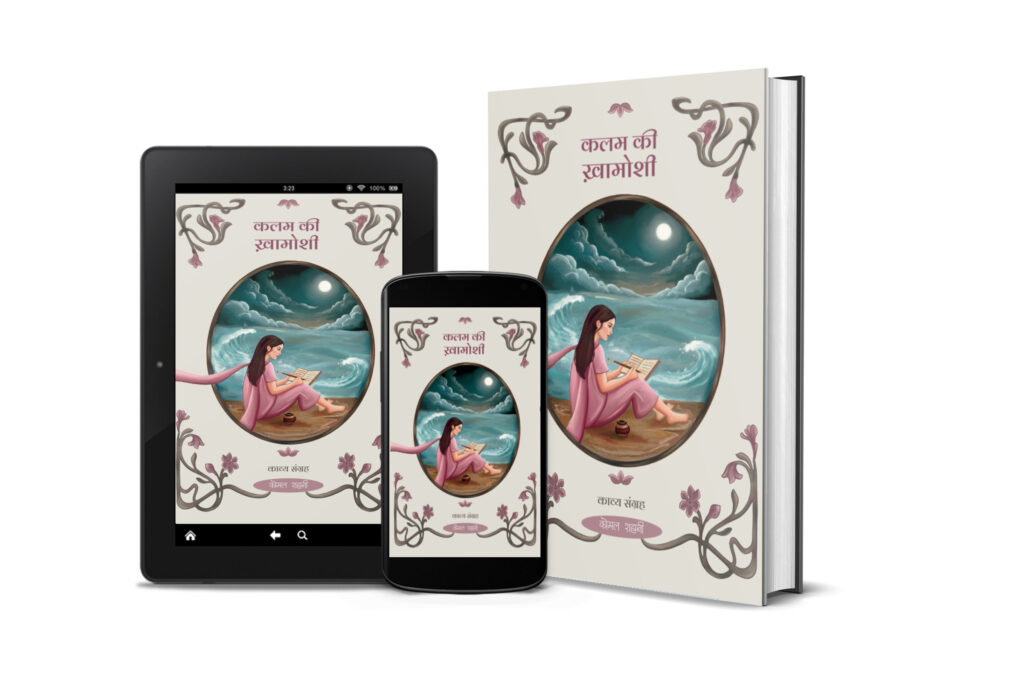
Some books speak loudly. Others whisper and stay with you long after the last page. Kalam Ki Khamoshi belongs to the latter. Rooted in everyday observations, quiet emotions, and the power of what remains unsaid, Komal’s poetry collection invites readers to pause, breathe, and listen closely.
In this candid conversation, Komal opens up about her poetic process, the meditative stillness behind her writing, the structure of the book, and her journey as a writer. What follows is an intimate dialogue—one that mirrors the very silence her poems so beautifully articulate.
“Hi Komal, thank you for taking the time to answer our questions. Our team has read the book and has had a few questions related to your book.”
1. First, I would like to say that the title sounds intense. Also, your writing is deeply rooted in everyday life. What moments or emotions most often spark a poem for you?
Thank you. As you rightly said, my writing is deeply rooted in everyday life, so day-to-day moments, news, or even small observations can spark a poem for me.
The title itself, Kalam Ki Khamoshi or “The Silence of the Pen,” reflects my fascination with everything that remains unsaid: the thoughts we hesitate to share, the feelings we bury, and the stories that live quietly between the lines.
“It immediately sets the tone for what readers can expect.”
2. You’ve described writing as a form of meditation. How does this inner stillness reflect in the poems of Kalam Ki Khamoshi?
Yes, writing acts as a form of meditation for me. When there is chaos outside, writing helps me calm down and find stillness within, and that quietness naturally reflects in Kalam Ki Khamoshi.
The poems carry a sense of peace because they are born from that inner silence and there is no noise, no rush, just sadhe hue shabd that allow readers to pause, breathe, and relate.
“I agree, your poems don’t rush; they sit with you while reading.”
3. The book is divided into three sections: My Emotions, Complaints, and Dreams. How did this structure come into being, and what does each section represent in your personal journey?
The poems in Kalam Ki Khamoshi are a collection written over a long period of time and across a variety of themes. Since there wasn’t a single unifying topic, I didn’t want to present them without any structure or thought.
That’s when the idea of dividing the book into sections came to me based on the emotions and themes each poem carried. My Emotions, Complaints, and Dreams represent not just my inner journey, but also what any reader might feel while reading those poems. Each section reflects a different emotional space, allowing the poems to resonate more personally and honestly.
“The structure feels intuitive.”
4. Many poems in the collection explore silence, unspoken pain, quiet resistance, and unheard emotions. What does “silence” mean to you as a poet?
For me as a poet, silence is not emptiness, it is a space full of emotions. It represents unspoken pain, restrained strength, and the thoughts we carry quietly within ourselves.
Silence allows me to listen more deeply to my inner voice, and through poetry, I try to give that silence a language without disturbing its stillness.
Many believe that those who speak less have little to say, and my words are for them to remind them that silence, too, is rich with thought and feeling.
“This perspective reframes silence not as absence”
5. Your poems move between personal introspection and social reality. How do you balance writing for the self while speaking for society?
I believe the personal and the social are deeply connected. When I write from a place of honest introspection, those emotions often mirror what many others are experiencing but may not articulate.
By staying true to my own feelings, my poetry naturally begins to speak for society quietly reflecting shared realities through individual experience.
“That quiet reflection makes the poems feel personal yet universally relatable.”
6. There is a recurring presence of womanhood, sometimes fragile, sometimes fiercely resilient. How much of your own experience shaped these voices?
A great deal of my own experience has shaped these voices. As a woman, I have lived through moments of fragility, silence, resilience, and quiet strength, and those emotions naturally find their way into my poetry.
While the poems are personal, they also echo the shared realities of many women finding strength not always in loud resistance, but often in quiet endurance and self-awareness.
“It actually gives your poems their emotional authenticity.“
7. Reading, as you say, was your first love. How has reading influenced your poetic voice and choice of themes? Would you like to recommend any books or authors to our readers?
Reading was my first love, and it played a huge role in shaping my imagination and my voice as a writer. It allows you to travel through different worlds, lives, and emotions without moving, and teaches you how much can be said with very few words.
That influence reflects in my poetry, the ability to express depth and meaning in just a few lines.
As for recommendations, I deeply admire Sudha Murthy for her simplicity, Khaled Hosseini for the emotional power of his storytelling, and Gulzar Saab for his mastery over language and layered depth, each of them has influenced me in their own way.
“Those influences clearly echo in your work.”
8. How was your publishing experience? Would you like to give any advice to budding authors and writers?
My publishing experience has been both challenging and deeply rewarding. It taught me patience, resilience, and the importance of trusting my voice, even during moments of doubt.
To budding writers, I would say that write consistently and honestly, without worrying too much about perfection or validation. Read as much as you write, stay true to your emotions, and remember that your voice matters. Every story takes its own time to find its readers.
“Thank you, I am sure your thoughts will resonate strongly with writers navigating their own journeys.”
9. What do you hope readers take back with them after finishing Kalam Ki Khamoshi—comfort, courage, reflection, or something else entirely?
I hope readers take back a sense of comfort and reflection above all. Kalam Ki Khamoshi is meant to make them pause, sit with their own emotions, and feel understood especially in moments of silence or uncertainty.
If the book offers them quiet courage, reassurance, or the feeling that their unspoken thoughts matter, then it has done its job.
“Great”
10. Looking back at your first book in 2018 and now Kalam Ki Khamoshi, how do you see your growth as a writer and as an author?
Looking back at my first book in 2018 and now Kalam Ki Khamoshi, I see a significant evolution both as a writer and as an author. Earlier, my focus was more on telling a story; today, I’m more comfortable with silence, subtext, and emotional restraint.
With time and life experience, my writing has gained depth, maturity, and clarity. As an author, I’ve also grown more patient and confident in my voice, understanding that meaningful writing often unfolds slowly and finds its own rhythm.
“Kalam Ki Khamoshi feels like a writer fully at ease with her voice.”
Kalam Ki Khamoshi is not a book meant to be rushed through, it asks readers to slow down, to listen, and to acknowledge the emotions that often remain unnamed. Through silence, Komal gives language to what many feel but struggle to express.
In a world that constantly demands noise, her poetry is a quiet reminder that stillness, too, has a voice—and sometimes, it speaks the loudest.
Grab your copy now-
On Amazon
On Flipkart
Follow Komal on your social media for future project update-
Instagram