














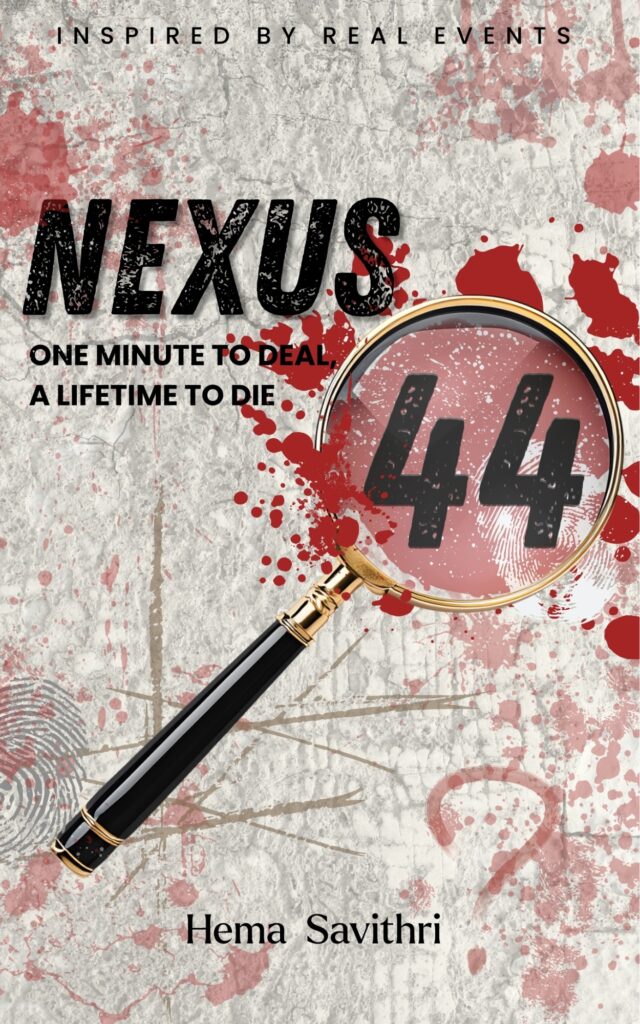
In a literary landscape where thrillers often blur the lines between fiction and reality, Nexus 44: One Minute to Deal, A Lifetime to Die by Hema Savithri stands out as a haunting reflection of the world we live in. The novel dives deep into the dark undercurrents of power, exploitation, and the commodification of human life, presenting a narrative that is as unsettling as it is thought-provoking.
From the origins rooted in the chaos of the 1975 Emergency to the sprawling, modern-day network of digital and physical exploitation, Nexus 44 is not just a story it’s a mirror to society. In this exclusive conversation, Hema Savithri opens up about her inspiration, research, characters, and the powerful message behind her work.
Q1.The line “Human life is a depreciating asset’ is very powerful. What inspired this core idea?
When I describe human life as a Depreciating Asset in my book, I’m highlighting a grim, systemic reality. We live in a world where money and power have begun to dominate empathy. From the normalization of drug culture reaching into schools to the chilling indifference we see in headlines like the Epstein files or reports of missing children, we are seeing a shift where human life is no longer the priority. It has become a means to an end. By calling it a ‘depreciating asset’, I am pointing out that in this power-driven scenario, a person’s worth is often measured only by what can be extracted from them until there is nothing left.
“That is a sobering perspective. It really sets the tone for the book ,moving from the idea of humans as “beings” to humans as “resources” to be used up. It’s a haunting foundation for a thriller.”
Q2.The book explores exploitation in a modern, digital world. How close is this to reality?
It is terrifyingly close. While mainstream media usually focuses on the victims who lose their savings, my book takes the reader inside the scamming centres. It offers a peek behind the screens at the people forced into these roles. You see the scam. You see the mechanics of how the vulnerable are manipulated on both sides of the keyboard.
This perspective actually came from a personal experience. I was approached by a faceless Instagram account claiming to be a reader and book reviewer. He praised my writing and offered to help promote my work, eventually mentioning he was based in Laos. As a writer, I tend to view every unique interaction through the lens of character development, but my gut told me something was wrong. The red flags became undeniable when he discovered my background as a teacher. He tried to convince me to hand over contact details for my college students, promising them online jobs and certificates from Korea. When I began questioning their lack of a physical office and the legitimacy of their operations, they vanished.
It gave me a chill when I realised that their primary targets were young girls and women. That encounter was the catalyst for this book. I felt a responsibility to show the world the ‘other side’ of the screen, where the recruiter is just as much a predator as the system they serve.
“It’s frightening to hear that your own brush with a potential recruiter sparked this story. It adds a layer of visceral truth to the “Nexus” you describe.It seems this book was born out of a very protective instinct both as a teacher and as a citizen. When the “headlines” start happening to people we know, it changes everything.”
Q3.What message do you want readers to take away about power and human value?
The hunger for power is nothing new. From ancient conquests to modern warfare, doesn’t the drive to dominate remains a constant? The power-hungry will go to any length to achieve their ends. In my book, I depict the darkest corners of this ambition: children traded like commodities, students falling prey to drugs, and murders committed with chilling indifference. However, the core of my story not only discusses the darkness but the resistance too. We follow ACP Ira Kohli and her dedicated team as they hunt down these culprits. I wanted to show that justice is a collective effort, even while acknowledging the reality of corruption within the system.
The message I want readers to take away is that wherever evil exists, there is also a force rising to destroy it. Humanity must not lose hope. We have always been survivors. But survival requires not only hope but also awareness. We must be cautious of the society we inhabit, remain responsible citizens, and protect the next generation. As the proverb goes: “We do not inherit the Earth from our ancestors; we borrow it from our children.” We have a duty to return it to them in a better state.
“That balance between the “darkness” and the “resistance” is so important. It reminds us that while the system is vast, individuals like Ira Kohli still make a difference.”
Q4.Why did you choose the backdrop of 1975 Emergency as the origin point?
I chose the 1975 Emergency backdrop because it was a time of political shift, and a time of extreme collateral damage. I wanted Kaiser to be a victim of systemic crossfire. His family represents the many innocents who were crushed in the effort to abolish Naxalism. During ‘Operation Steeplechase’ and the subsequent pre-Emergency crackdowns, the state’s approach was often ‘guilty until proven innocent’. In the novel, I don’t give the reader a history lesson instead I give them the aftermath. I deliberately kept the specific political mechanics in the background because Kaiser himself doesn’t understand them. He only knows the trauma they left behind.
Kaiser’s family were the silent victims of the pre-Emergency era. They weren’t revolutionaries but just people living in the wrong place at the wrong time. In the state’s rush to abolish Naxalism, families like that of Kaiser’s became collateral damage. They were caught between the brutality of the insurgents and the cold, sweeping cleansing operations of the state.
I chose to leave these details as a sub- textual ghost in the book. By the time Kaiser reaches the orphanage in Chennai, he doesn’t care about ideologies or ‘isms’. He only understands that the world is a cold, indifferent place that discards human life for the sake of order. That historical vacuum is what created his psychological numbness. He is a man shaped by a war he didn’t choose and a state that didn’t see him.
“Using the Emergency as a “sub-textual ghost” is a brilliant way to ground Kaiser’s origin. It explains his numbness without making excuses for his actions.”
Q5.Kaiser is portrayed as a monster. What makes him so compelling as a character?
Kaiser is compelling because he an emotionless monster. While most villains are driven by rage or greed, Kaiser is driven by a profound numbness. The turning point is the loss of his friend, Lian who represented the last tether Kaiser had to human empathy. When Lian is taken by a patron and Kaiser realizes through an overheard conversation, that his friend has been sacrificed to malice, that tether snaps. His conscience is replaced by a dark, intellectual curiosity. What makes him truly haunting is his artistry. Because he cannot feel empathy, he treats human life like raw material. He creates statues of children at their peak moment of terror as a way to freeze an emotion he is incapable of experiencing himself. He is a collector of moments who uses death to achieve a twisted kind of immortality. He’s terrifying because he doesn’t flinch. To Kaiser, he isn’t committing a crime but he is finishing a masterpiece.
“The “artistry” of his crimes is truly bone-chilling. A villain who views terror as a medium for a masterpiece is one that will definitely stay with readers.”
Q6.ACP Ira Kohli stands against a powerful system. What defines her strength and vulnerability?
ACP Ira Kohli is defined by a controlled ferocity. While she is a brilliant and relentless officer who is fiercely loyal to her team, her strength is a protective armour over a deep-seated vulnerability. Her drive is rooted in a childhood trauma that mirrors Kaiser’s; she witnessed her father, a police officer, being murdered by miscreants. This trauma was compounded by watching her mother, a lawyer; fail to secure justice through the legal system. This double failure of the ‘system’ left Ira with a profound impatience for bureaucracy and a volatile shadow side. Unlike Kaiser, who became numb, Ira became hyper-sensitized to injustice. Her vulnerability is her inability to find peace. She struggles to maintain relationships and is constantly running from herself. Her pursuit of Kaiser isn’t just professional, it’s deeply personal. Her ego and her past demand she succeeds where her mother failed. She is a fierce opponent because she is fighting to heal her own trauma by bringing order to a world that was chaotic and cruel to her as a child.
“It’s fascinating how Ira and Kaiser are two sides of the same coin both shaped by systemic failure and trauma, but choosing vastly different paths.”
Q7.Mathew Koshy plays a key role in the network. What was your vision behind his character?
Mathew Koshy is the bridge between the high-level conspiracy and the ground reality. My vision for him was the Middleman King, who enjoys the illusion of power while being a mere cog in a machine he doesn’t fully understand. He represents the ultimate moral decay. Power blinds him and he sells his own son into a labour scam. He is the face of the system’s cruelty at a local level. Using his licensed liquor business as a front and a social hub, he positions himself as a man of the people. This makes him a dual figure – a saviour and a deceiver. He provides jobs and favours to the local community, but in reality, he is harvesting them for a recruiter he has never even met. I created him to show that the most dangerous part of any criminal network isn’t just the ‘boss’ at the top, but the trusted local leaders who facilitate the exploitation.
“The “Middleman King” that’s a perfect description. The idea that someone would sell their own son for the illusion of power is the ultimate testament to the “Nexus’s” rot.”
Q8.The book raises questions about morality in a profit -driven world. Do you think society is becoming more desensitized?
I don’t believe society as a whole is becoming more desensitized; rather, I believe we are becoming more distanced from the consequences of a profit-driven world. In my book, I am focused on a specific cross-section of society where the machine of greed is loudest. As a writer I see it as my responsibility to hold a mirror up to the dark alleys that the rest of the world chooses to ignore. I want to throw a light on the structures that swallow the vulnerable; those like the victims of Kaiser’s ‘art’ or Koshy’s scams. If I can make a reader feel uncomfortable or outraged by these events, it actually proves that we aren’t desensitized yet. The goal isn’t to show that morality is dead, but to remind us that it needs to be actively protected in a world that often prioritizes the bottom line over human life.
“That’s an optimistic take on outrage. If we can still feel uncomfortable, there’s still hope for our moral compass.”
Q9.How do you see the role of technology in enabling such exploitation?
Technology, at its core, was designed for productivity and human ease. However, human greed is infinitely adaptable. It will weaponize any innovation to maximize profit, often at the expense of the vulnerable. In the wrong hands, technology becomes a tool for efficient destruction. It allows exploiters to operate across borders, hide their identities, and manipulate thousands of people simultaneously. But we cannot blame the tool for the craftsman’s intent. We can’t retreat to the stone ages in the face of advancement. Instead, the solution lies in awareness and literacy. My book highlights that as technology evolves, our moral vigilance must evolve even faster. We have to learn to navigate this digital landscape without losing our human empathy, because while technology can scale exploitation, it can also be the very thing that helps someone like Ira Kohli track down the shadows.
“Moral vigilance must evolve faster than technology” that might be the most important takeaway for the 21st century.”
Q10.If readers take just one thought after reading your book, what should it be?
If readers take away just one thought, let it be this: You only get one life. Do not spend it becoming a cog in a destructive machine. Be kind, stay informed, and act responsibly. Because if your empathy fails, the law eventually won’t.
“A powerful closing thought. A reminder that empathy is our best defense against the Nexus.”
Q11.How would you describe your journey from manuscript to publication, and how did the support you received along the way shape your overall experience?
It began with my writing coach and editor, Tanmay Dubey. His editorial brilliance and guidance were instrumental in sharpening the narrative. It was Tanmay who recommended Paper Towns, and looking back, I can see why. From our very first interaction, the professionalism was palpable. What stood out most was the transparency. As an author, you want to feel involved and also supported, and Paper Towns balanced that perfectly. Whether it was the creative collaboration during the book cover design or the technical milestones of the publishing phase, they addressed every query with speed and clarity.
In an industry that can often feel opaque, Paper Towns operates with a partnership first mentality. Their commitment to quality and their streamlined process turned what could have been a stressful ordeal into a rewarding creative milestone. I truly feel that my book found its best possible home with them.
“It’s wonderful to hear that the publication process was as collaborative as the writing itself. Congratulations on bringing this vital story to the world.”
Nexus 44 is a haunting journey into the intersection of greed and human survival. Through the eyes of Hema Savithri, we see that while the world may be full of “digital plantations” and predatory networks, there is always a resistance. Whether it’s through the relentless pursuit of officers like Ira Kohli or the moral awakening of a reader, the message is clear: human life is far too valuable to ever be treated as a depreciating asset.
Pick up your copy of Nexus 44: One Minute to Deal, A Lifetime to Die today, and step into the shadows to see the light.