













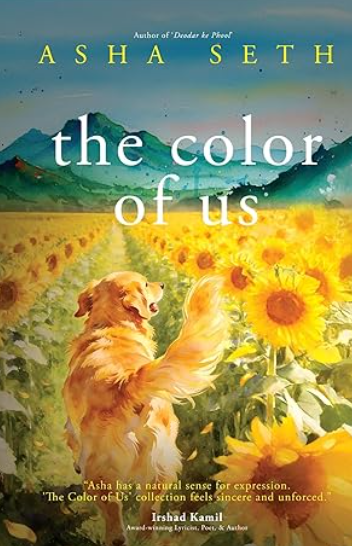
Poetry has a way of reaching the quiet corners of the human heart and those spaces where emotions linger, memories resurface, and healing begins. In her latest collection, ‘The Color of Us’, Asha Seth invites readers into a deeply reflective and emotionally resonant journey. Known for her earlier work Deodar ke Phool, Seth returns with a collection that expands beyond the personal and embraces the shared human experience.
In this conversation, we explore her inspirations, creative process, and the evolving journey of a poet who sees the heart as both a battlefield and a sanctuary.
Q1. How does this collection differ from your previous book Deodar ke Phool?
Deodar ke Phool and The Color of Us differ in their purpose. While former was written with a very personal motive, latter was written for the masses, the poetry-lovers. The two also differed in language and that made the writing process stimulating and, liberating in a sense.
“That shift from personal to universal shows your voice reaching to a wider audience.”
Q2. Who do you think will connect most strongly with this collection and what emotions or thoughts did you hope readers would experience while reading this book?
Anyone who picks up the book will connect with it strongly because these are experiences common to one and all. Readers will experience nostalgia, joy, and a rush of memories that we tend to forget over time.
“It gently nudges readers to reconnect with forgotten emotions like rediscovering parts of themselves.”
Q3. Your book describes the heart as both a “battlefield and sanctuary.” What does that duality mean in your poetry?
The heart is a battlefield and a sanctuary both in terms of the experience one is living at a given point in time. For instance, when you lose someone – it’s a battlefield, but when you’re in love – it’s a sanctuary.
“That contrast is beautifully captures how the same heart can hold both pain and peace”
Q4. How do you define the “human journey” that your poems celebrate?
Human journey is a sum together of all the experiences and emotions one lives. Without them, it can hardly be called a journey!
“A powerful reminder that every emotion, whether joyful or difficult, plays a role in shaping who we become.”
Q5. What does your poetry writing process usually look like?
There is no set process or pattern. Somedays, it’s bleeding words on paper through nights. Somedays, it’s all about just reading and cherishing past work. Muse, as I have come to experience, can take any form!
“That unpredictability makes the process feel very organic—almost like poetry chooses the moment, rather than the other way around.”
Q6. Did writing this collection change the way you understand yourself or your experiences?
Yes, it certainly changed me in the way I perceive the world. Poetry always leads you inward.
“That inward journey often brings the deepest transformations.”
Q7. How has your journey as a poet evolved since your first book?
Ironically, ‘The Color of Us’ was written way before ‘Deodar ke Phool’ was even conceived. Having said that, I am always evolving as a person as I travel a lot, talk to strangers, note down stories, journal precious or precarious moments, and those shape up my later ego – the poet.
“It’s interesting how timelines in creativity don’t always follow a straight line.”
Q8. What authors or poets have influenced your writing style?
There’s a bunch of them but I’ll keep it short. Leo Tolstoy, Charles Bukowski, Jhumpa Lahiri, Daphne du Maurier, Ruskin Bond, to name a few!
“That’s a wonderfully diverse list each of them brings a unique emotional depth and storytelling style.”
Q9. Are you currently working on another poetry collection or writing project?
Yes, a collection of short stories titled – The Hermit from Benares & Other Stories.
“That sounds exciting moving into short stories must open up an entirely new creative dimension for you.”
Q10. What advice would you give aspiring poets who want to publish their work?
I’ll quote Stephen King – The more you read, the better you write. And never doubt yourself. Getting a publisher, getting recognition, or monetary success comes much later!
“Timeless advice focusing on the craft and believing in one’s voice truly forms the foundation of any creative journey.”
Through ‘The Color of Us’, Asha Seth reminds us that poetry is not just about words—it’s about feeling, reflecting, and ultimately, understanding ourselves a little better. Her journey as a poet continues to evolve, shaped by experiences, people, and moments that leave a lasting imprint.
As readers turn the pages of this collection, they are invited not just to read, but to pause, feel, and rediscover the many colors that make up the human experience.
Grab your copy of The Color of Us by Asha Seth and dive into its world of emotions.