












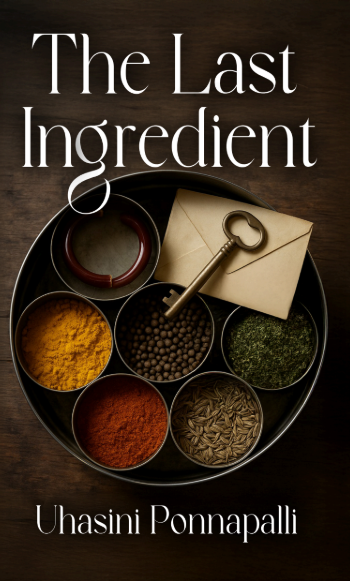
Behind every compelling novel lies an equally compelling story of its creator. In this exclusive conversation, we sit down with the author of The Last Ingredient to explore the journey from numbers to narratives, from finance to fiction, and from quiet observations to emotionally resonant storytelling.
Balancing a demanding career in finance while pursuing a passion for literature, the author brings a unique perspective to the writing process. Through this interview, we uncover the inspirations behind The Last Ingredient, the themes that shaped its characters, and the realities of navigating the publishing world as a debut novelist.
Join us as we delve into the creative mind behind a story that promises to leave readers reflecting long after they’ve turned the final page.
1. Between polynomial and quadratic equations, when did you adapt the habit of reading and how did it lead you to write one of your own books?
I grew up more comfortable with numbers than novels. Reading became a habit almost accidentally, somewhere between problem sets and burnout. Books turned into a way to slow my brain down instead of constantly optimizing it. Writing came later, once I realized I wanted to create the same quiet impact on someone else that reading had on me.
Many readers are surprised to learn that not every writer begins as an avid bookworm. Your background in finance and academics makes your journey especially intriguing, so we wanted to start at the very beginning.
2. How has it been navigating both the finance world and the literary world?
It has honestly been a mental split-screen. Finance trains you to be precise, skeptical, and efficient. Writing asks you to sit with uncertainty and emotion. Balancing both forced me to accept that I don’t have to be one thing. The contrast keeps me grounded and prevents burnout in either space.
These are two worlds that often seem to stand at opposite ends of the spectrum. We were curious to know how you’ve managed to embrace both without losing your sense of self.
3. What inspired you to write Chaya’s story?
Chaya’s story came from observing how people carry grief and resilience quietly. I was interested inthe lives that look ordinary from the outside but are emotionally intense underneath. Chaya became a vessel for questions I didn’t have clean answers to, especially around identity, loss, and survival.
Every memorable character is born from an idea, an emotion, or a question that refuses to let go. We wanted to understand where Chaya’s journey truly began.
4. Did you have a specific reason for choosing a title that slightly misdirects the concept or purpose of the book? OR Why did you choose to title your book, The Last Ingredient? Was it metaphorical?
The title is absolutely metaphorical. It hints at something simple and tangible, but the book isn’t about food or completion in a literal sense. The last ingredient is what people are always searching for to feel whole, understood, or at peace. It’s meant to mislead just enough to make you curious.
A title is often a reader’s first encounter with a book. The Last Ingredient immediately sparks curiosity, and we couldn’t resist asking about the thought behind this intriguing choice.
5. If you were to describe your book as an amalgamation of two iconic books to ever have been published, which would it be?
I’d describe it as a blend of The Kite Runner and The Bell Jar. One for its emotional depth and cultural weight, the other for its quiet psychological intensity. The overlap is in how personal pain intersects with the world around you.
Literary influences often reveal a great deal about an author’s creative instincts. It was fascinating to hear which timeless works resonate most closely with your own novel.
6. How do you deal with writing blocks, if any, that come with writing a novel with such heavy motifs?
I don’t romanticize writing blocks. When they hit, I step away instead of forcing words. I read, journal badly, or just sit with the discomfort. Heavy themes demand honesty, and forcing that usually backfires.
Writing emotionally demanding fiction can be as challenging as it is rewarding. We wondered how you navigate those inevitable moments when creativity slows down.
7. Did you feel the pressure to write the right things or go by ethics while this book was in process?
There was pressure, but not in the way people assume. I wasn’t trying to be politically correct or morally perfect. I was more concerned with being truthful. Ethics mattered, but authenticity mattered more.
Stories dealing with complex emotions often invite important questions about responsibility and authenticity. We were interested in understanding how you approached that balance.
8. Do you have a target audience for this book?
I didn’t write with a narrow audience in mind. That said, the book tends to resonate with people who like introspective stories and aren’t afraid of emotional weight. It’s for readers who don’t need everything spelled out.
While every story finds its readers differently, we wanted to know who you imagined would connect most deeply with The Last Ingredient.
9. How has publishing been for you? Could you shed some light on your journey so far?
Publishing has been humbling. It’s slow, confusing, and not nearly as glamorous as it looks online. At the same time, holding the finished book made every frustrating step worth it. I’ve learned patience the hard way.
Completing a manuscript is only part of an author’s journey. Publishing brings its own lessons, challenges, and triumphs.
10. That being said, do you look forward to writing another book or will it be one and done?
Definitely not one and done. Writing this book cracked something open. I don’t know what the next one looks like yet, but I know I’m not finished.
After pouring so much into a debut novel, many authors wonder what comes next. Naturally, we had to ask whether this is just the beginning of your literary journey.
Our conversation offered a thoughtful glimpse into the mind of an author who effortlessly bridges the analytical world of finance with the emotional depth of fiction. The Last Ingredient is more than a novel—it is an exploration of identity, resilience, grief, and the quiet complexities that shape human lives.
We thank the author for sharing their creative journey, honest reflections, and the inspiration behind their work. As readers prepare to immerse themselves in Chaya’s story, one thing becomes clear: this is an author with many more stories waiting to be told.
We wish them continued success and eagerly look forward to their next literary venture.
Grab your copies of The last ingredient