














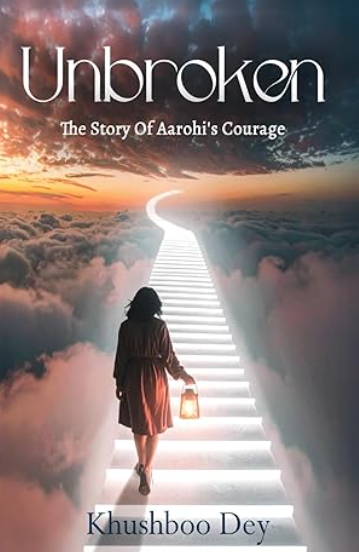
Books have a way of touching us where words alone often fail, and Unbroken by Khushboo Dey is one such story. Following the extraordinary journey of Aarohi a young woman who battles life’s challenges with grace, faith, and quiet resilience the novel is both a tribute to human courage and a guide for those navigating unseen struggles.
From the bustling streets of Jaipur to dreams that cross borders, Aarohi’s story is one of self-discovery, healing, and love that endures despite pain. Through every fall and rise, she teaches that healing is not about going back to who we were, but about becoming who we’re meant to be.
Khushboo Dey, a writer passionate about resilience, hope, and human emotion, brings this debut novel to life inspired by a true story, and crafted as a heartfelt homage to those who refuse to surrender to fate. We spoke to her to uncover the inspiration, process, and messages behind Unbroken.
Q1. Unbroken is a powerful title. What does it represent to you personally?
“Unbroken” represents the quiet strength of the human spirit the ability to bend, to hurt, to fall apart internally, and yet not lose oneself. For me personally, Unbroken is about resilience that isn’t loud or dramatic. It’s about surviving emotional pain, betrayal, loss, and moments where giving up feels easier and still choosing to move forward. The characters may be wounded, but their core remains intact.
The title reflects the idea that even when life fractures us in ways no one can see, our essence, our hope, and our will to rise can remain unbroken. This novel is a reminder that strength doesn’t always look like winning sometimes, it simply looks like enduring.
“It’s incredible how the title captures the essence of quiet strength. It sets the stage perfectly for a story about resilience that resonates deeply with readers.”
Q2. What inspired you to write this book, and when did the idea first take shape?
The idea for Unbroken came from watching someone I love fight battles no one else could see. My best friend was going through a phase where life seemed to take more than it gave dreams were delayed, strength was questioned, and silence became a constant companion. From the outside, everything looked normal. But from close enough, you could see how heavy each day was, and how much courage it took just to keep going. There were moments when words failed, when advice felt useless, and all that remained was endurance. Watching that kind of quiet resilience changed the way I understood strength. It made me realize that some of the bravest people are the ones who never talk about what they’re surviving. Unbroken began there as an attempt to hold space for those unspoken struggles. It is not just a story; it is a reflection of countless hearts that continue to beat despite disappointment, loss, and emotional exhaustion. This book is for anyone who has ever felt unseen, unheard, or on the verge of giving up and yet chose to take one more step forward.
“It’s so moving to see how real-life experiences shaped the story. The authenticity of these emotions makes Aarohi’s journey so relatable.”
Q3. Is Unbroken rooted in personal experiences, imagination, or a blend of both?
Unbroken is deeply rooted in personal experiences not just mine, but the lived realities I have closely witnessed. The emotions, conflicts, and resilience portrayed in the story come from real moments, real pain, and real strength that I’ve seen up close. While the narrative and characters are shaped through imagination, the emotional truth of the book is very real. The fear, the silence, the hope, and the determination are drawn from experiences that many people go through but rarely speak about. That blend of lived emotion and storytelling allowed me to create something honest and relatable. Unbroken isn’t meant to feel like fiction detached from reality it’s meant to feel familiar, as though parts of the story could belong to anyone reading it. At its core, the book is a reflection of real lives, real struggles, and the very real possibility of staying unbroken even when life tries its hardest to break you.
“The fusion of real emotion with storytelling is powerful. It really allows readers to see themselves in Aarohi’s journey.”
Q4. Aarohi’s strength feels quiet yet powerful. How did you shape her resilience without making it dramatic or exaggerated?
Aarohi’s resilience was shaped intentionally through restraint. I didn’t want her strength to be loud or performative, because real resilience rarely is. In life, strength often shows up in small, unnoticed choices getting up on difficult days, holding on to dignity in silence, and continuing forward even when no one is watching. Instead of dramatic turning points, I focused on her inner responses: how she thinks, how she absorbs disappointment, and how she chooses hope even when circumstances don’t immediately change. Her resilience lies in endurance rather than rebellion, in persistence rather than spectacle. By allowing her to feel vulnerable without being broken, and strong without being invincible, Aarohi becomes relatable. Her journey reflects the kind of strength many people carry quietly every day the kind that doesn’t demand attention, but leaves a lasting impact.
“I love that focus on inner strength. It makes her resilience feel genuine, something readers can truly connect with.”
Q5. The story beautifully explores healing. Why do you believe healing is about becoming, not returning to who we were?
I believe healing is about becoming because life doesn’t leave us unchanged. Experiences shape us, break parts of us open, and reveal truths we didn’t know we carried. Wanting to return to who we were often means wanting to undo pain and that’s rarely possible. In Unbroken, healing isn’t portrayed as restoration of the past, but as evolution. The characters don’t erase what hurt them; they learn to live with it, to grow around it, and to let it transform them into something wiser and more aware. Healing, in this sense, is not about going back it’s about moving forward with intention. Becoming allows room for grace. It accepts that strength can be softer, that joy can be quieter, and that scars can coexist with hope. This idea sits at the heart of the story: that we don’t heal by pretending nothing happened, but by allowing ourselves to change and still believe in life. Unbroken explores this journey of becoming in all its complexity,reminding readers that growth after pain is not a loss of self, but the discovery of a deeper one.
“That perspective on healing is profound. It reminds us that growth after hardship is not a return, but a transformation.”
Q6. Which phase of Aarohi’s journey challenged you the most while writing?
The most challenging phase of Aarohi’s journey to write was the period after her marriage, when she finds herself navigating emotional isolation alongside serious health struggles. This phase required great sensitivity, because it unfolds at a time when life is expected to feel settled, safe, and complete.
What made it particularly difficult was portraying her pain without turning it into overt conflict or dramatization. Aarohi isn’t fighting visible battles; she is enduring quiet loneliness, physical fragility, and emotional exhaustion, all while trying to preserve her sense of self. Capturing that kind of silent suffering meant allowing restraint, pauses, and unspoken emotions to carry the weight of the narrative. This phase is pivotal to her transformation. It is where her resilience is tested most deeply not through ambition or escape, but through patience, endurance, and the courage to survive when strength is demanded without support. It is in these quiet moments of endurance that Aarohi’s story truly becomes Unbroken and it is here that readers will feel her journey most deeply.
“It’s clear that this part of the story required both sensitivity and precision.”
Q7. Love in Unbroken transcends pain and loss. What kind of love did you want readers to understand through this story?
In Unbroken, I wanted readers to understand love beyond romance or idealism. The love explored in the story is quiet, imperfect, and resilient the kind that exists even when circumstances are painful and outcomes are uncertain. This is a love that doesn’t always rescue or heal instantly, but stays present. It’s found in patience, in silent support, in choosing to care even when things feel broken. It acknowledges loss and disappointment, yet refuses to disappear because of them. Through Aarohi’s journey, love becomes a force of endurance rather than possession. It teaches that love doesn’t always mean holding on tightly sometimes it means allowing space, forgiveness, or even letting go while still wishing well.
Unbroken invites readers to see love as something deeper than happiness alone as the strength to remain human, compassionate, and hopeful, even after pain. It’s this kind of love gentle, enduring, and quietly powerful that lingers long after the last page and makes Aarohi’s story impossible to forget.
“It’s such a refreshing take on love realistic, patient, and enduring. Readers can feel its quiet power.”
Q8. As this is your debut novel, what fears or doubts did you face before publishing Unbroken?
As a debut author, my biggest fear before publishing Unbroken was vulnerability. Releasing a story that carries so much emotional depth meant accepting that readers would interpret it in their own ways some might connect deeply, while others might not. That uncertainty was daunting. I also questioned whether the quiet nature of the story would find its place in a world that often celebrates louder narratives. Unbroken doesn’t rely on dramatic twists; it rests on emotional truth, and I wondered if that subtlety would be understood. There was also the fear of putting something so heartfelt into the world and not knowing how it would be received. But ultimately, I realized that stories like this need to be told especially for readers who see their own unspoken struggles reflected in them.
Publishing Unbroken became an act of courage in itself. Letting go of doubt and choosing to trust the story was the final step in the journey one that I hope resonates with every reader who opens the book.
“It’s inspiring to see how you transformed vulnerability into a story that others can lean on. The courage to publish a deeply personal narrative is admirable.”
Q9. What would you like readers especially women navigating their own battles to take from Aarohi’s journey?
Through Aarohi’s journey, I want readers especially women navigating their own silent battles to feel seen, validated, and empowered. I want them to understand that struggling does not make them weak, and choosing to endure does not make them insignificant. Aarohi’s story is not about perfection or dramatic triumphs; it’s about reclaiming agency in spaces where voices are often softened or overlooked. It’s about learning that strength can be gentle, boundaries can be self-respect, and healing does not have to follow anyone else’s timeline. More than anything, I want readers to walk away knowing they are allowed to evolve. They are allowed to change, to grow, and to redefine themselves after pain without guilt and without apology. Aarohi’s journey is a reminder that becoming stronger doesn’t mean becoming harder; it means becoming truer to yourself. If Unbroken offers one promise, it is this: no matter how heavy your battle feels, your story is still unfolding and like Aarohi, you have the power to rise, reclaim your voice, and remain unbroken.
“This message will resonate with so many readers. Aarohi’s story becomes a mirror for women reclaiming strength quietly, yet powerfully.”
Q10. What message or feeling do you hope readers take away after finishing Unbroken?
After finishing Unbroken, I hope readers are left with a deep sense of recognition the feeling that someone has understood the parts of them they rarely share. I want the story to feel like a quiet companion, one that doesn’t offer easy answers but stays present through uncertainty and pain.
More than anything, I hope the book reassures readers that struggle does not erase identity, and hardship does not diminish worth. Unbroken isn’t about fixing life; it’s about learning how to carry it with grace, resilience, and self-respect. I want readers to close the final page feeling steadier than before, reminded that healing doesn’t have to be loud, strength doesn’t have to be hard, and survival itself is a powerful act.
“If you have ever felt close to breaking, Unbroken was written for you.”
“That closing sentiment is so comforting. It leaves readers feeling seen and encouraged, a rare gift in literature.”
Q11. As a first-time author, how was your experience with Paper Towns Publishers throughout the publishing process, and how did their team support you in transforming Unbroken from a story into a published book?
As a first-time author, the publishing process can feel both exciting and overwhelming, and that’s where my experience with Paper Towns Publishers truly made a difference. From the very beginning, their team treated Unbroken not just as a manuscript, but as a story that mattered. They guided me patiently through every stage structuring, design, and final production always taking the time to explain, suggest, and refine without ever trying to change the soul of the story. What I appreciated most was their sensitivity toward the emotional core of Unbroken. They understood that this wasn’t just fiction; it was a deeply human story, inspired by real pain, courage, and resilience.
As a debut author, I had doubts and questions at every step, but the team was consistently supportive, responsive, and encouraging. They gave me the confidence to trust my voice while helping me shape it into a book that readers could truly connect with. Paper Towns Publishers didn’t just help me publish Unbroken they helped me believe that my story deserved to be told. And that, for a first-time author, is the greatest support of all.
“It’s wonderful to hear how supportive collaboration can make all the difference. The partnership clearly helped your story reach its full potential.”
Unbroken is more than a novel : it is a companion for those navigating life’s silent battles. Through Aarohi’s journey, Khushboo Dey invites readers to witness the power of quiet resilience, the depth of enduring love, and the grace of healing through becoming.
As Khushboo shares, “If you have ever felt close to breaking, Unbroken was written for you.”
This debut novel is a heartfelt reminder that struggle does not erase identity, hardship does not diminish worth, and survival itself is a powerful act. Aarohi’s story is proof that no matter the challenges, one can rise, reclaim their voice, and remain unbroken.
Grab your copy now from the online portals below and dive into the inspiring journey of Unbroken!