













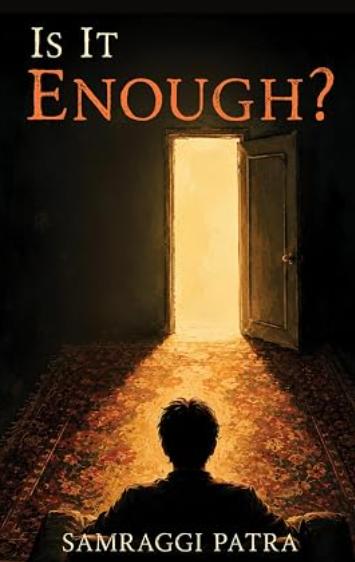
In a world that constantly celebrates extraordinary achievements, what happens to those who simply want to live an ordinary, meaningful life? Is It Enough? asks this powerful question through the story of Yoon Tsong, a young man living in a world where passion is visible and defines one’s place in society. Blending magical realism with deeply human emotions, debut author Samraggi Patra explores themes of identity, self-worth, healing, and the quiet courage of simply existing.
Written alongside a full-time job and born from personal reflection, Is It Enough? is both an intimate coming-of-age story and a comforting reminder that worth isn’t measured by achievement alone. In this exclusive conversation, Samraggi shares the inspiration behind her debut novel, the emotions that shaped its characters, and why Yoon’s journey is one that so many readers may see themselves in.
Q1. What inspired you to write Is It Enough?, and how did the idea of the ‘Lamp of the Soul’ first come to you?
I’ve always circled the same question: is it enough to just exist quietly, to live an ordinary life, without getting punished for it? ‘Average’ has become a kind of taboo, I feel Somewhere along the way we decided you don’t deserve a seat at the table unless you’re extraordinary, and the worst part is, we built that cage ourselves. We’re the ones enforcing the checklist.
I’m 23, and I never had a defined dream growing up. I finished college with no idea what I was supposed to become. By most standards, I’d call my life average. But I kept asking; why is ‘average’ an insult? Do I need to have a dream to become happy? If I’m content, shouldn’t that be the metric that matters, not how loudly I’m succeeding?
Is It Enough? More than anything else, it is my comfort light to people who are struggling with their own life and worth, just because they are made to feel they are average.
As for the Lamp of the Soul, passion is such a private thing. It is internal, and I think most people want to keep it that way. So I asked: what if that privacy was stripped away? Would the world celebrate that, or just find new ways to divide people by it? I wanted the answer to live in magical realism rather than commentary. Some things are truer when they’re dressed up as fantasy instead of said outright.
“Your book challenges one of today’s biggest societal pressures the need to constantly be exceptional. It’s a refreshing and deeply relatable premise.”
Q2. Yoon Tsong is a character many readers may see themselves in. How did you create him, and how much of him reflects your own thoughts or experiences?
My first instinct was that he shouldn’t be someone overly visible. He had to be average, blendable, the kind of person nobody remembers for anything specific. That’s actually why I didn’t make him the only person in the world without a flame. If he were the sole exception, that would make him special by default, and I didn’t want that. I wanted him to be more like the second lead who’s always orbiting someone else’s hero arc.
He’s a culmination of my thoughts, feelings, and emotions, and he’s heavily built on the artist Agust D’s introspection. Agust D’s music is very open about his loss, traumas, struggles and opinions. I wanted to give Yoon struggles, real fights, but nothing dramatic or over-the-top, because that’s where a story loses its real-life texture. People don’t go through trauma every single day, but they do spend a lot of time wondering if a small thing is even worth being upset about, because they’ve set their own threshold for pain so high. At the same time, I didn’t want him to become a caricature of his own suffering. He’s just a normal person.
He has pain, but he doesn’t build his whole identity around it. He doesn’t have an obvious purpose or passion, and everyone around him keeps trying to make him feel that absence, like he’s a burden for not having one. He feels it, but he doesn’t take it out on anyone. There’s rage in him, frustration at the world, but he never lets it consume him. Instead, he keeps finding quieter ways to push back, mostly through his music. He stays private, keeps his emotions locked down, and isolates himself when things get hard, just to sort his own mess out on his own terms. These things are purely me. And honestly, I think that’s most people. You’re meant to feel for him, not feel sorry for him.
“Yoon feels incredibly authentic because his struggles aren’t dramatic they’re quietly familiar.”
Q3. If you had to describe Is It Enough? in one sentence, what would you say?
In a world where exceptionalism is the new normal, it’s a book about being, and refusing to apologize for it.
“Sometimes, one sentence can capture the heart of an entire story. Your answer beautifully reflects the core message readers can expect from the novel.”
Q4. You wrote this novel while balancing a full-time job. What kept you motivated through that journey?
It was difficult, but never in the way of losing interest or inspiration. I always knew this was a book I had to write. Before this, I’d started several other books that never got finished, simply because I lost interest along the way. This one was different. I think what motivated me most was the book itself, the characters, really. I see so much of myself in them, in their dynamics, in the problems they’re navigating. So many of those conflicts mirror my real life and the people around me. Writing it became a kind of catharsis. A way to channel my thoughts, my insecurities, everything, and actually work through them by putting them on the page. And the character himself kept me hooked. Whenever I sat with something from Yoon’s perspective, he’d give me a reaction I didn’t expect. The way Yoon moves through things kept pulling me back in. Even during writer’s block, I never really lost the thread. I’d step away from the book for a few days, live my life, and inevitably something would happen that would find its way back into the story. It was that organic. I think that’s partly because this book was written for myself, too. It’s how I wanted to be comforted.
“Writing a novel alongside a demanding career is no small feat. It’s inspiring to hear how your characters became both your motivation and your companions throughout the process.”
Q5. You describe writing this book as an act of catharsis. How did the process change you personally?
I’m a very inward person by nature. Whatever emotions, frustrations, or rage I carry, I keep to myself, don’t tell people, even about the things I want to achieve, however small. I think I’ve always compartmentalized a lot, kept things locked away rather than let them affect me the way they actually do. There are incidents in my life I simply never wanted to open up or feel again. To write Yoon convincingly – to actually make you feel what he was feeling – I had to go back and explore a lot of that in myself. And in doing that, I ended up processing a lot of it alongside him. I started seeing those old wounds from a different angle. In a way, it felt like accepting my own flaws, my own nature, because if I wanted him to arrive at his own version of acceptance, I had to sit with how I saw myself, and how I wanted to see myself. So in that sense, writing this became a channel for getting rid of a lot of negative feelings I’d been carrying. And once that’s out of you, even a little, you’re one step closer to healing.
” It’s remarkable how storytelling doesn’t just transform readers it transforms writers too.”
Q6. As this is your debut novel, what was the biggest challenge you faced while writing and completing it?
This is going to sound ironic, but I think my biggest challenge was my own insecurities. The thing that demotivated me most was constantly wondering whether people would find the book as comforting as I did, whether it would make sense to them, whether it held even a little relevance to their own lives. I kept getting into my own head, convinced the book might not be enough. And the irony wasn’t lost on me; here I was, writing a book about being average and unremarkable, while trying to make it remarkable enough for other people. Somewhere in the middle of writing, I caught myself doing exactly that, and I had to step back. That insecurity, though, was also what drove a lot of the narrative changes, story arc shifts, chapter-wise revisions, entire sections rewritten. Every time I reread it, I saw it differently, so the edits never really stopped. And then, of course, there was the job. Balancing a full-time job with writing left almost no room for anything else. For months, my routine was: go to work, come home, freshen up, write until 5 or 6 in the morning, sleep for two hours, and repeat.
“It’s interesting that the very insecurities your book explores also became part of your own writing journey. That honesty makes your story feel even more genuine and relatable.”
Q7. Who do you think will connect most deeply with Is It Enough?
Mainly young adults, people just out of the safety net, building a life for themselves for the first time, with no real idea what to do next. But also anyone who’s ever felt the fear of being average, who’s gotten caught in that trap of “everyone else is doing it, so I have to too,” who’s felt the weight of societal expectation pressing them toward some version of extraordinary they never asked for. I don’t think this book belongs to one specific kind of reader – I think it’s pretty much universal.
“It’s easy to imagine readers from all walks of life finding pieces of themselves within its pages.”
8. What can readers expect from Volume 2?
Book One was all about Yoon’s internal world – the introspection, the internal struggles. Book Two picks up after he’s already begun healing, but now it’s less about him and more about life pushing back. He’s stepped out without a safety net, and that comes with real uncertainty – in his relationships, his work, even his own definition of happiness. A lot of that is going to shift. Without giving too much away – let’s just say the road to a 7 members “dreamers 101” is anything but smooth. But it’s not only his own insecurities he’ll be navigating anymore. Until now, he’s been so absorbed in his own lack of passion that he hasn’t had much room to hold space for anyone else. In Book Two, he has to start processing the people around him too – take some accountability for his friends, show up for them the way he’s learning to show up for himself. It’s part of growing up, really. Just a lot more external, and a lot more angst.
“It sounds like the next chapter of Yoon’s journey moves beyond self-discovery into the complexities of adulthood, relationships, and responsibility. That evolution promises an exciting continuation of the story.”
Q9. If you could see your own ‘Lamp of the Soul,’ what colour do you think it would be today, and why?
A heavily flickering blue Or probably not just blue. It’d be somewhere between blue and red. Blue for the logical, overthinking side of me; red for the impulsive part that acts before it thinks.
“Your answer feels just as layered and introspective as the novel itself.”
Q10. How has your journey of bringing this book to readers with Paper Towns Publishers been, and what has the experience taught you as an author?
The biggest thing it taught me was patience, and more than that, trusting myself. Trusting that I know this world best, because I’m the one who built it. A lot of people will try to hand you their own ideas, their own version of what your story should be, and expect you to fold it into your script. I don’t think that’s how it should work, especially when you’re building something from scratch. Listen to your own voice, your own thoughts, your own perspective, above everyone else’s. As for the journey with Paper Towns; it’s been genuinely smooth. I’d actually reached out to them years ago and completely forgotten about it, until I was recently reminded. It felt a little like destiny, honestly. But beyond that, the process itself, once onboarding was done, was easy. I didn’t have to stress much over getting the book out into the
world.
“Publishing a debut novel is a milestone filled with both excitement and uncertainty. It’s wonderful to hear how the experience reinforced the importance of trusting your own creative voice.”
With Is It Enough?, Samraggi Patra offers more than a debut novel she offers reassurance to anyone who has ever questioned their worth in a world obsessed with achievement. Through Yoon Tsong’s deeply personal journey and the imaginative symbolism of the Lamp of the Soul, the book gently reminds readers that fulfillment doesn’t always come from standing out; sometimes, it comes from learning to accept who we already are.
As readers await Volume 2, one thing is certain: Is It Enough? begins a conversation that extends far beyond its pages a conversation about identity, purpose, healing, and the quiet strength found in simply being enough.
Every page asks a question, every chapter brings you closer to yourself grab your copy of Is It Enough? today.